video

Sabrina T. est actuellement doctorante en 3ème année de thèse au laboratoire de Microbiologie et de Génétique Moléculaire (LMGM) du CNRS à l’Université Toulouse III.

Depuis son entrée au collège, Sabrina s’est destinée à une carrière scientifique. Issue d’un milieu modeste, elle a bénéficie de bourses, mais a aussi travaillé durant les vacances scolaires. Durant ses années d’études universitaires, elle a assuré des gardes de nuit dans des laboratoires d’analyses médicales pour compléter cette aide.

Il y a 4 ans, alors qu’elle était en Master I, elle a choisi de porter un voile. Elle portait le voile lors de son stage de Master II, en 2006, et lors du concours d’attribution des bourses de recherche, concours à l’issue duquel elle a pu commencer sa thèse dans l’équipe dans laquelle elle a effectué son Master II.

Sa bourse, un CDD de 3 ans, est gérée par l’université. A aucun moment il n’a été fait allusion au foulard qu’elle portait.

Bien intégrée dans l’équipe de recherche, Sabrina menait une vie sociale normale. En mars 2008, alors qu’elle déjeunait avec deux collègues à la cantine du CNRS, elle a été brutalement prise à partie par une personne sur ce campus, qui après lui avoir déclaré qu’elle n’avait pas le droit de porter le voile, lui a demandé qui elle était, de quel laboratoire, et qu’elle avertirait immédiatement l’administration du CNRS. Ce qu’elle fit….

Un changement décisif est intervenu début juillet 2008 lorsque l’« adjoint au fonctionnaire de Sécurité de Défense » du CNRS s’est déplacé à Toulouse. Sa visite ne concernait pas sa fonction officielle (protection des données sensibles au CNRS) et il a déclaré publiquement qu’il est venu « régler » la question de l’interdiction du voile dans les labos du CNRS [1]. Sa visite a été aussi l’objet d’une rencontre restreinte avec l’administration du CNRS et de l’université et avec des directeurs d’unités.

Sabrina est convoquée dès le 11 juillet à une réunion où elle est mise en tête en tête avec le président de l’université Gilles Fourtanier, son secrétaire général, le directeur du LMGM, l’administratrice déléguée du CNRS, la DRH du CNRS. Son directeur de thèse et son avocate, venus la soutenir, sont exclus sous le prétexte qu’il s’agit d’une ‘réunion hiérarchique’. C’est un ultimatum : retirer le voile ou s’exposer à des « mesures nécessaires ».

Le 10 décembre 2008, le secrétaire général et la DRH de l’université rendent visite à Sabrina et ne se satisfont pas de ce qu’ils voient : elle leur a pourtant affirmé qu’elle ne portait plus un voile islamique mais un fichu traditionnel (à la mode « sicilienne »). Mais il faut qu’elle soit tête nue, sinon c’est, disent t-ils, un « manque de neutralité ».

A 7 mois de sa soutenance de thèse, le 26 février 2009, elle est licenciée pour faute professionnelle sans préavis ni indemnité par le Président Fourtanier, sans qu’aucun conseil de discipline ait été réuni, ni aucune réunion contradictoire.

Elle est accusée d’avoir « causé un trouble à l’ordre public et porté atteinte à la liberté de conscience de ses collègues ». Le prétexte donné au licenciement tient dans un paragraphe où il est question d’un « principe de laïcité affirmé par l’article premier de la constitution » [2] et qui s’appuie, sans le citer, et pour cause, sur l’Article L.141-6 du code de l’éducation [3]. La décision de licenciement est une violation flagrante des libertés assurées par la Convention Européenne des Droits de l’Homme [4].

Les conséquences ? Elles sont dramatiques :

Sabrina est toujours étudiante en thèse mais depuis le 26 février 2009, elle est sans ressources. Elle n’a droit à aucune indemnité.

Comment va-t-elle pouvoir rédiger sa thèse, son article et soutenir avant le mois de septembre, tout en entreprenant des démarches afin de trouver une solution financière ?

Est-il acceptable de faire subir cela à une étudiante à 7 mois de la fin d’un parcours universitaire ayant demandé tant de sacrifices et d’efforts ??

Cette mesure est injuste et sans fondements. Nous considérons que l’université doit être un lieu d’études ouvert à toutes et tous, sans pré requis sur l’origine sociale ou culturelle ou sur les convictions politiques ou religieuses, nous exigeons de la présidence de l’université l’annulation de cette mesure disciplinaire et qu’il ne soit dorénavant posé aucun obstacle au bon déroulement futur du travail de thèse de Sabrina.


Notes :

[1] A quel titre « un fonctionnaire de défense » se mêle t-il de la tenue vestimentaire d’une étudiante en thèse ? C’est ce que vous ne saurez pas en consultant ses fonctions :
http://www.sg.cnrs.fr/FSD/fsd/missions.htm

[2] Le ‘principe de laïcité’ est un objet introuvable. Quand à l’article premier de la constitution, il est écrit : « La France est une république, laïque, démocratique et sociale. Elle assure l’égalité devant la loi de tous les citoyens sans distinction d’origine, de race, ou de religion. Elle respecte toutes les croyances ». Mais où est le respect des croyances dès lors que l’appartenance à une religion devient le motif de licenciement ? Où est l’égalité devant la loi dès lors qu’un seul genre, une seule religion, un seul signe religieux, est pointé du doigt et devient un motif de discrimination ?

[3] Article L.141-6 du code de l’éducation : « Le service public de l’enseignement supérieur est laïque et indépendant de toute emprise politique, économique, religieuse ou idéologique ; il tend à l’objectivité du savoir ; il respecte la diversité des opinions. Il doit garantir à l’enseignement et à la recherche leurs possibilités de libre développement scientifique, créateur et critique ».

[4] Convention Européenne des Droits de l’Homme, Article 9 - Liberté de pensée, de conscience et de religion 1. Toute personne a droit à la liberté de pensée, de conscience et de religion ; ce droit implique la liberté de changer de religion ou de conviction, ainsi que la liberté de manifester sa religion ou sa conviction individuellement ou collectivement, en public ou en privé, par le culte, l’enseignement, les pratiques et l’accomplissement des rites. 2. La liberté de manifester sa religion ou ses convictions ne peut faire l’objet d’autres restrictions que celles qui, prévues par la loi, constituent des mesures nécessaires, dans une société démocratique, à la sécurité publique, à la protection de l’ordre, de la santé ou de la morale publiques, ou à la protection des droits et libertés d’autrui.

Source

Pour soutenir Sabrina Trojet financièrement, cliquer ici.

Pour signer la pétition, cliquez ici.


ما دامت العجوز العكري فرنجة قادرة على فعل كلّ هذا بمواطنيها فلماذا إذن نلوم كلاب حراستها الذي ينهشون لحم مواطنينا؟ أليس الكلب دوما على قلب صاحبه كما يقال؟
تحيّاتي،

إقرأ المزيد...

لقد فقدت الرغبة في كل شيء منذ يوم "الإثنين الأسود". فقدت الرغبة في الكتابة، في القراءة، في العمل، في أن أمارس حياتي بكلّ بساطة. لا أعلم لماذا أكتب هذا النص هنا ولا ما هي علاقته بالطابور الخامس أو أيّة سجالات فكرية من أيّ نوع كان! ما أعلمه أنّ نفسي مليئة بالغضب حدّ الثورة وبالألم حدّ البكاء وبالكثير من الإحباط حدّ اليأس! لست أكتب كي أستدرّ عطف أحد. ولكنّني أكتب كي أصبح أقوى!
ربّما عزائي الوحيد أنّني على ثقة بأنّني قطعا لست أتعس امرأة على وجه الأرض، على الأقلّ في هذه اللحظة الباهتة من الزمن. أحاول أن أتذكّر ذلك كلّما نزلت بي نائبة من نوائب الدهر. أحاول أن أنظر إلى النصف المليء من الكأس وأن أحافظ على بعض من التفاؤل رغم كل شيء. رغم كل الألم والعذاب، أحاول دائما أن أحيي بعضا من الأمل في نفسي.
قد لا تفهمون ما أقوله وقد تعجزون عن كنه ما أشعر به في هذه اللحظة وقد لا تقدرون على معرفة حجم المأساة ومداها وعنفها ولكن رغم كل شيء، من المؤكّد أن ذلك سيجعلني أقوى لأنّه لحدّ الآن على الأقل، لم يقصم ظهري بعد! تعرّضت منذ سنوات طويلة إلى هزّات عنيفة في حياتي وتمكّنت بفضل الله من تجاوز تلك المراحل الصعبة. مؤلم جدا أن تتلقّى طعنة في الظهر من أقرب وأحبّ الناس إلى نفسك. ذلك موقف قاس جدا بالتأكيد وأحيانا قاتل ومدمّر! لكن ماذا عساك أن تفعل؟ تتساءل بالتأكيد أين الخطأ؟ هل كنت مساهما في ذلك الخطأ؟ ما حجم مسؤوليتك فيما حدث؟ وماذا عليك أن تفعل لإصلاح الأمر أو إنقاذ ما يمكن إنقاذه؟ ما يؤلم
ك ليس فقط الطعنة التي خلّفت جرحا ينزف بلا رحمة ولا انهيار كل البرامج الشخصيّة والعمليّة التي تعمل عليها منذ سنين في لحظة غادرة من زمن لا يرحم ولا كلّ الإستثمار العاطفي والمادي والأدبي الذي ذهب دون رجعة وبلا مقابل معنوي. ولكن أكثر من كلّ ذلك شعورك بأنّك سلّمت ثقتك وسعادتك وآمالك إلى الشخص الخطأ وربّما في الزمن الخطأ أيضا!
بعد ليلة عملت فيها إلى ساعة متأخّرة يأتي صباح جميل، يوم إثنين مشرق ومنعش. رغم تعبك ورأسك التي تدور بلا توقّف كرقّاص ساعة قديمة تشعر ببعض النشاط. تجري في كلّ الإتجاهات فهذا طفلك الذي يحتاج إلى حمّامه وفطوره ولمجته وروضته وذلك عملك الذي ينتظرك وأشياء أخرى كثيرة! مسؤولياتك صعبة وثقيلة ولكنك تجاهد نفسك وتعمل بكل طاقتك لأن تكون دوما في المستوى المطلوب! تدلف إلى مكتبك وقهوتك الصباحيّة في يدك. تضع عنك حقيبتك وتمتم ببعض الكلمات الجالبات للحظّ، تجلس إلى حاسوبك وتنقر بعض النقرات. تتنقّل بين بريدك وملفّات عملك. تتمطّى قليلا بكسل وتتناول رشفة من تلك القهوة العبقة. فجأة يتصّل
بك أقرب الناس إليك. لا يبدأك بالسلام ويدخل مباشرة في الموضوع. تنظر إلى النافذة الصغيرة بدهشة ويقف عقلك عند أيقونة القلم التي تتنقّل جيئة وذهابا بينما مخاطبك على الضفّة الأخرى بعيدا عنك بألاف الأميال في مكان ما من هذا العالم الفسيح، يكتب شيئا ما. تمرّ الثواني ثقيلة وتتوالى الرسائل القصيرة ويصدر عليك حكم ثقيل، حكم من كلمتين! حكم أشبه بضغطة على زرّ تفجير قنبلة نوويّة! عندها تتنبه إلى معنى نسبية اينشتاين! البارحة ليس كاليوم ولن يعود الزمن إلى الوراء أبدا. عندها فقط تعرف ما الفرق بين السعادة والتعاسة وتعيش للحظات ذلك التحوّل بين الحالتين. تجد نفسك شعوريا تحاول استيعاب الموقف و لاشعوريا تقاتل لإعادة الأمور كما كانت فالطّبيعة الإنسانية تبحث دوما على التوازن. كم هي غريبة هذه الحياة! تأخذ منك في لحظة ما أنعمت به عليك لسنوات. تأخذه كما الموت يأخذ الحياة بلا استئذان أو رحمة!
يكبر الألم في نفسك، ترفض تصديق ما يجري، ويستحيل الأمر إلى كابوس. تنطلق دمعة حا
رّة على خدك. دمعة خانتك في لحظة ألم. دمعة تتبعها أخرى وأخرى ويستحيل الدمع الى شلاّل. تستنزف في دقائق معدودة كل مناديلك الورقيّة. يتوقّف عقلك عن العمل. تفقد التركيز. تفقد الرغبة في كل شيء ولكن الكارثة الكبرى أنّك يجب أن تعمل وأن تشارك في اجتماعات اليوم وتلتقي بمن يجب أن تلتقي بهم! دموعك دليل على طبيعتك الإنسانيّة. تلك الدموع التي تدلّ على ضعف تلك الطبيعة وهشاشة بنيتها. تلك الدموع التي لولاها ما تمكّنت من التخلّص من بعض الألم والضغط!
تم
رّ الأيّام بطيئة متشابهة لا رائحة لها ولا طعم. تستحيل ضحكتك إلى نفاق وتزلّف تحاول أن تخفي به ذلك البركان الذي يغلي في أعماقك. تحاول أن تتماسك وأن تقول للآخرين بشكل غير مباشر بأنّك بخير رغم تلك السحنة الذابلة والضحكة المصطنعة والهالات السوداء حول عينيك من أثر الأرق والسّهاد. تحاول رغم تشتّت فكرك وعدم تركيزك أن تقاوم لإثبات وجودك. تحيّيك كاتبة القسم صباحا ولكنّك لا تسمعها. تزورك بعد دقائق في مكتبك، تستأذنك في الدخول ولكنك لا تنتبه إليها إلاّ عند المحاولة الثالثة. تنتفض كالملسوع وتهبّ إلى استقبالها والإعتذار إليها. تسألك مالك؟ فتحاول أن تكذب عليها ولكن تردّدك يكشفك! تنبري في تعديد ملاحظاتها حول حالتك الغريبة في المدّة الأخيرة. لا تجد ما تقوله لها فتكتفي بالصمت وأنت تنظر إلى الأرض طالبا الصفح والغفران لذلك أو تلك التي تسبّبت في هذه العاصفة التي تجتاح حياتك وتحيلها إلى أيّام جرداء قاحلة آلامها أكثر بكثير من آمالها.
تعود في المساء
إلى منزلك وتنزوي في فراشك. تفتح التلفيزيون وتمرّ على كل القنوات ولكنك لا تشاهد أيّا منها ولا تتذكّر بعد دقائق ماذا يعرضون هذا المساء. تأخذ كتابك الذي بدأت قراءته قبل العاصفة بأيّام، تمرّ على بعض الفقرات مرّات ومرّات ولكنك تقرأ ولا تفهم ولا تستوعب. تأخذ حاسوبك المحمول وتحاول تمضية بعض الوقت ولكنك سريعا ما تلقيه جانبا. تحاول النوم وتتقلّب لساعات في فراشك دون أن يغمض لك جفن رغم شعورك بالتعب والإرهاق والضعف الذي يعتريك منذ أيّام. تتمنّى أن تقوم صباح الغد وقد مُسحت ذاكرتك تماما. تحنّ إلى بعض من الهدوء والإطمئنان دون جدوى. ولكن رغم كل ذلك يهتف في أعماقك صوت بأن قاوم، تجلّد، اصبر، وامض إلى الأمام. لا تضعف، لا تستسلم ولا تتراجع! تسخر من الصوت وأنت في قمّة إحساسك بأنّك الآن أكثر شخص تعاسة وشقاءً على وجه البسيطة. ولكن لا يلبث إلاّ أن يرتفع من جديد. تحاول أن تفكر في الأمر. في كل الأحوال، كان بالإمكان أن يكون الأمر أكثر سوءًا ممّا هو عليه. ماذا لو فقدت طفلك؟ ماذا لو تعرّضت إلى حادث ووجدت نفسك في قسم الحالات الحرجة؟ ماذا لو... ماذا لو...؟ بعد استعراض بعض الحالات، تحمد الله عمّا أنت فيه وتقول بالتأكيد غدا سأكون أقوى فالضربة التي لا تقصم الظهر تقويّه!

إقرأ المزيد...
كتبت هذا النص: عبرات، ألم و أمل في الجمعة، يونيو 19، 2009


video

فيلم قصير لأروى وليد يقدّم بعض الشهادات الحيّة حول الإسلاموفوبيا في بريطانيا
المصدر
التحميل هنا

إقرأ المزيد...
كتبت هذا النص: عبرات، ألم و أمل في الاثنين، يونيو 15، 2009


الوقت - نادر المتروك:
تُبذل جهود حثيثة لإيضاح الصّورة ''الصّحيحة'' للإسلام، وتحديداً في موقفه من المسائل الحرجة في العصر الرّاهن، إلا أنّ النتائج عند الطرف الآخر لا تبدو دائماً مرضية. المراكز ودُور الأبحاث الرّصينة، وغير الرّصينة، التي تُعنى بدراسة ظاهرة الإسلاموفوبيا، أو الخوف من الإسلام، تُشير إلى أنّ المعضلة القائمة أمام جهود التّصحيح وإزالة المخاوف قد تكون حتى الآن مفقودة وبعيدة عن الإدراك السّليم. بالنسبة للنظرة السّائدة، فإنّ هذه الظاهرة تشير مركزياً وبشكل أحادي إلى الموقف الاعتباطي للغرب تجاه الإسلام، وتوجّسه من خسران المنافسة الحضاريّة في حال تُرِك الباب أمام التقدّم للإسلام. ولكن الوقائع على الأرض تؤكّد أنّ مثل هذه النظرات العاجلة إنّما تغطّي على الأسباب المركّبة للظاهرة، وبدوافع لا تحمل حسّ المسؤولية في أغلب الأحيان. في هذا الإطار، يُركز مركز الدّراسات والأبحاث في المغرب على تقديم جهوده في مجال يُسمّيه بتصحيح ''صورة الإسلام''، ويُنظّم في هذا الخصوص في نوفمبر/تشرين الثاني المقبل ندوة دوليّة تحت عنوان ''ظاهرة الإسلاموفوبيا وسبل مواجهتها''. ولأجل تسليط الضوء على طبيعة عمل المركز واهتماماته، والإطار الذي تجيء فيه الندوة، كان هذا الحوار السّريع مع رئيس المركز الدكتور حسن عزوزي.

في البداية، وبما أنكم ترأسون المركز، هل يمكن تقديم تعريف لمركز ''الدراسات والأبحاث في مجال تصحيح صورة الإسلام''؟ ولماذا تمّ تأسيسه؟
- تأسس المركز بتاريخ 7 دجنبر2007 وهو جمعية علمية أكاديمية. ويهدف إلى تطوير البحث العلمي في مجال تقويم وتصحيح ما يكتب ويقال عن الإسلام شريعة وحضارة. كما يهدف إلى تنسيق جهود الباحثين والسعي إلى تكريس العمل الجماعي الهادف إلى إنجاز وتحقيق مشروعات علمية رائدة. ويحرص المركز على المساهمة في تصحيح صورة الإسلام في الغرب عن طريق ربط جسور الاتصال والتواصل مع مختلف المراكز والمنظمات والجمعيات الثقافية الإسلامية المهتمة بالعواصم الغربية. فضلاً عن مدّ جسور التعاون مع الهيئات والمؤسسات غير الإسلامية المتفهمة للإسلام في الأمور المشتركة. وقد تمّ التفكير في تأسيس المركز نظراً للحاجة الملحة في الآونة الأخيرة لقيام مراصد بحثية تعمل على رصد ومتابعة كل ما يقال ويكتب عن الإسلام والتنبيه على حالات وصور تشويه الإسلام عن طريق الاحتجاج لدى الجهات المعنية ثم عن طريق الردّ والتصحيح.

الإسلاموفوبيا ظاهرة واقعية لا متخيّلة
تعدّون لإقامة مؤتمر خاص لدراسة ظاهرة ''الإسلاموفوبيا''. ما رأيكم في وجهات النظر التي تعتبر هذه الظاهرة مجرّد صورة متخيّلة في العقل المسلم، وأنها ظاهرة متولّدة في الدّاخل الإسلامي نتيجة الإحساس بالقهر الحضاري في مقابل الصّعود الحضاري، وبأثره المهيمن، للحضارة الغربيّة؟
- استعداد المركز لتنظيم ندوة دولية في موضوع (ظاهرة الإسلاموفوبيا وسبل التعامل معها) نابع من رؤية واضحة في الموضوع، ذلك أن الاقتناع بوجود الظاهرة التي مفادها أن هناك خوفاً مرضياً من الإسلام لا يحتاج إلى الرجوع إلى دراسات علمية وأكاديمية في الموضوع، ولكن يكفي أن يلاحظ المرء المتابع لطبيعة علاقة الإسلام بالغرب في السنوات الأخيرة مدى التوجّس الذي يعبّر عنه الغربيون تجاه الإسلام في مختلف المحافل والمنابر، سواء كانت سياسية مثل تصريحات بعض الساسة الغربيين التي مهما اعتبرت فلتات لسان إلا أنها في واقع الأمر تفصح عمّا يجيش في النفوس، أو كانت دينية مثل تصريحات البابا والقس فرانكلين جراهام وغيرهما. أو كانت إعلامية كما تعبّر عنها يومياً مختلف وسائل الإعلام الغربية بالصوت والصورة والكلمة وحتى الكاريكاتير.
إنها فعلا ظاهرة واقعية وليست متخيّلة، والذين يعجزون عن متابعة ورصد حيثياتها وملابساتها، وبالأحرى التعامل معها ومواجهتها، هم الذين يستمرئون التهوين من شأن الظاهرة والتقليل من حجمها والتوهم بأنها ظاهرة متولدة من الداخل الإسلامي نتيجة الإحساس بتقدم الآخر وهيمنة حضارته. ولا شك أن الذين يعتقدون هذا الاعتقاد ينطلقون من تعميم نظرية المؤامرة التي أفرزها بعض المفكرين الإسلاميين أواخر القرن الماضي والتي تفيد ميل الكثير منا إلى تعليق أخطائنا وعيوبنا وعجزنا على مشجب المؤامرة الغربية، أي أن الغرب هو الذي يسعى دائماً إلى إبقائنا متخلّفين عاجزين ومتواكلين. لقد اعترف كثير من الغربيين العقلاء والمنصفين بوجود الظاهرة سواء من خلال مؤلفات أصدروها أو من خلال تصريحات عبّروا عنها أو غير ذلك. بل إن هنالك تقريراً بريطانياً صادراً عن لجنة تضمّ عدداً من المفكرين البريطانيين يحمل اسم (المسلمون البريطانيون والإسلاموفوبيا) يثبت أن الإسلاموفوبيا ظاهرة خطيرة في بريطانيا.

هناك علاقة جدلية بين تصحيح النظرة إلى الإسلام (من الخارج)، وتصحيح النظر إلى الإسلام (من الداخل)، أي بين استقبال الإسلام من جانب الآخر، والتجديد الدّيني من جانب المسلمين، والبعض يرى استحالة تغيير النظرات السّلبية المكوّنة في الخطاب الآخر، ما لم يتواز ذلك، وبشكل جدّي وحثيث، مع النهوض الحضاري والإصلاح الدّيني الإسلامي. ما رأيكم في هذا الرأي؟ وما السّبيل المنهاجي لمثل هذه المعادلة التي تبدو عسيرة في كثير من الأحيان؟
- صحيح أن تصحيح صورة الإسلام في الخارج يبدأ من تصحيح الصورة من الداخل والنهوض بإصلاح شامل وجذري. ولا يستقيم ذلك إلا بتغيير حال الأمة وفقا للمنهج الرشيد والأسلوب القويم. ومن المعلوم أن صناعة العداء للإسلام في الغرب وإنتاج الصّور النمطية السّلبية الموغلة في الازدراء بالإسلام والمسلمين؛ إنما ينبع من الوقوف عند أنماط ونماذج من سلوك المسلمين لا يعبّر عن حقيقة مبادئ الإسلام وتعاليمه، مما يسْهل معه ربط تلك السلوكيات والأعمال بالإسلام كدين يغذي تصرفات المسلمين. لنأخذ على سبيل المثال ما يقوم به بعض المنتسبين للإسلام من أعمال عنفٍ وتطرف ضد مصالح الغربيين، فإن الاتهام بالعنف والإرهاب إنما يتوجّه مباشرة إلى الإسلام كدين وحضارة.

المسلمون في الغرب والمهمات المنتظرة
ما المهمات المناط القيام بها بالنسبة للمسلمين في الغرب لأجل الإسهام في عملية تصحيح النظرة إلى الإسلام، ومجابهة ظاهرة ''الإسلاموفوبيا''؟ وهل من المتاح للمسلمين في أوروبا وأميركا القيام بدور حقيقي في هذا الاتجاه في الوقت نفسه الذي يمارسون فيه واقع الاندماج مع الواقع الغربي العام؟
- أمام المسلمين المقيمين في الغرب مسؤوليات جسام تجاه مهمة تصحيح صورة الإسلام. وتعتبر الكفاءات العلمية المسلمة في الغرب الأقدر على الإسهام في مواجهة ظاهرة الإسلاموفوبيا، ومواجهة الحملات الإعلامية الغربية، وتصحيح الصّور النمطية التي تنتجها مختلف مكونات الإعلام الغربي. وهذا الأمر إنما يتسنى من خلال استقطاب هذه الكفاءات المهاجرة وتوجيهها والتأكيد على أهمية دورها خصوصا وأنها تمثل مدخلا من مداخل توطيد العلاقة بين العالم الإسلامي والغرب.
إن المسلمين المقيمين في أوروبا وأميركا يُتاح لهم القيام بدور حقيقي في هذا الاتجاه خصوصاً على مستوى تعميق جسور الحوار الثقافي والحضاري مع المؤسسات الإعلامية والثقافية الغربية بما يخدم مبادئ الاحترام المتبادل وترسيخ قيم التفاهم والتعايش وعدم التهجم على معتقدات وقناعات الآخر. إن هؤلاء مؤهّلون لرصد ومتابعة ما ينتجه الغرب من صور نمطية عن الإسلام والمسلمين، وبإمكانهم العمل على نهج أسلوب الإنكار والاحتجاج والمطالبة ببيان الحقائق وتصحيح الصور النمطية واستخدام وسائل الضغط عبر الإعلام المرئي والصحافة المكتوبة. وكل ذلك كفيل بضمان مستوى أرفع في مجال تحسين صورة الإسلام والمسلمين والتخفيف من حدة ظاهرة الإسلاموفوبيا.


إقرأ المزيد...


video

إقرأ المزيد...
كتبت هذا النص: عبرات، ألم و أمل في الأحد، يونيو 14، 2009

ثمة يقين يبدو لي، وبخاصة إثر كل حادثة هجوم ضد الإسلام ورسوله العظيم، بأن تنامي الإسلاموفوبيا تعد ضرورة ملحة لأكثر من تيار أيديولوجي، وسلاحا ناجعا للعديد من التيارات السياسية العالمية. ويكفي للتدليل على ذلك الرجوع إلى الإحصائيات المتعلقة بأعداد المهاجرين لأوروبا من بلاد إسلامية، حيث بلغ عدد المهاجرين من شمال أفريقيا إلى فرنسا 2.4 مليون في العام 1975، مقارنة بأقل من 100 ألف شخص في العام 1946، كما قفز عدد المهاجرين الأتراك لأوروبا من 715 ألفا العام 1974 إلى 3.5 مليون في 2005.

رافق ذلك تضاعف عدد العاطلين عن العمل بأوروبا إلى أكثر من 160 % في الفترة من 1978-1982. ولم تلبث أحداث الحادي عشر من سبتمبر المشؤومة أن منحت هاجس الخوف على الهوية الأوروبية من موجات الأسلمة المتصاعدة بُعدا آخر فأصبح المسلم “عدوا إرهابيا”!! بعدما كان مجرد متلصص يدخل الحُرمة الأوروبية دون طريقة شرعية ويُخشى من تأثير نمط حياته على موروثات الحداثة وتركة العلمانية.

وفي تطور لاحق، نشأ ما يمكن تسميته “الابتزاز بالإسلاموفوبيا”، والذي يصور الإسلام باعتباره قالبا جامدا غير قابل للدراسة أو النقاش، ودينا مغايراً له وضع خاص فوق حرية الرأي والتعبير. ومع أخذ هذه الظاهرة في التنامي انتشرت الكتابات بشأنها، وبخاصة بعدما وضع الفيلسوف الفرنسي دوفيليه كتابه المعنون بـ“مساجد رواس”.

وبالرغم من ذلك، ظل المصطلح غائما في عمومه رغم شيوعه وتداوله، إلى أن قامت مؤسسة The Runnymede Trust، بأول محاولة جادة لتقعيده سنة 1997 حيث ربطت المفهوم وضبطته وفق ثمانية معايير محددة.

أول هذه المعايير، القول بأن الإسلام ليس إلا جسدا أحاديا جامدا قلما يتأثر بالتغيير. وثانيها، اعتباره آخر لا تربطه بالثقافات الأخرى قواسم مشتركة أو قيم متبادلة يتأثر بها أو يؤثر فيها. وثالثها، النظر للإسلام بدونية واعتباره دينا بربريا بدائيا جنسي النزعة ولا يمُت للعقلانية بصلة. أما رابعها، فيتمثل في الربط العضوي بين العنف والإسلام واعتباره مفطورا على الإرهاب ومنتشرا بحد السيف.

خامس هذه المعايير، النظر للإسلام باعتباره أيديولوجية سياسية تروم تحقيق مكاسب سياسية وعسكرية على حساب الآخرين. ويتمثل سادسها في الرفض القاطع لأية انتقادات بشأن الغرب تصدر من إسلاميين. أما سابعها، فيتمثل في توظيف هذا العداء لتبرير منظومة الممارسات العنصرية تجاه المسلمين وإقصائهم بعيدا عن حدود المجتمعات الغربية. ثامن هذه المعايير يتمثل في التسليم بالعداء للإسلام وللمسلمين واعتباره أمرا عاديا ولا غضاضة فيه!!.

وفي الواقع، كانت هذه المحاولة بمثابة نقطة البدء وشرارة انطلاق للعديد من التقارير والمتابعات الحقوقية، والتي أخذت تندد بالإسلاموفوبيا معتبرة إياها ضربا من التمييز العنصري وهدرا لحقوق وكيانات المسلمين في أوروبا. ففي العام 2005 أصدر مجلس أوروبا تقريره الخاص حول “الإسلاموفوبيا وتأثيرها على الشباب”، معرفا إياها بالقول: إن الإسلاموفوبيا هي التخوف أو الأحكام المسبقة تجاه الإسلام ومعتنقيه، سواء تم التعبير عن ذلك وفق الممارسات اليومية التمييزية، أو تطور نحو مزيد من أشكاله وممارساته الأكثر عنفا وضرواة.

وفي التقرير الذي أصدره المركز الأوروبي لمراقبة العنصرية وكراهية الأجانب، في ديسمبر 2006 بعنوان “التمييز العنصري والتخوف من الإسلام”، نجد عرضا واضحا لحجم التمييزات والاضطهادات التي تُمارس باتجاه المسلمين في كافة تفاصيل الحياة اليومية وفي مجالات العمل والتعليم والمسكن، كما لو أنها تشمل الفضاء العام برمته. حيث يبدأ التمييز بتوجيه الإهانات الشفهية، مرورا بالاعتداءات الجسدية، وليس انتهاءً بانتهاك حرمة الأماكن المقدسة ونبش القبور!!.

وفي الإطار ذاته، حذر العديد من القادة الدينيين الغربيين من خطورة تنامي الإسلاموفوبيا وشيطنة الإسلام، معتبرين إياها ضربا من الاستعمار الجديد. حيث صرح القس ميشال لولونج، أحد أهم القساوسة الكاثوليك في أوروبا كلها، أن ثمة جهات غربية تعمل على شيطنة الإسلام وتشويه صورته، مؤكدا أن هذا التوجه بمثابة استعمار ثقافي جديد.

وفي مقابل ذلك، اتهم جورج جينزفاين، السكرتير الخاص لبابا الفاتيكان، المسلمين بأنهم يخططون لأسلمة أوروبا، وأن الفاتيكان قلق بشأن مكانة الإسلام المتنامية هناك. وفي كل الأحوال، يجب عدم التقليل من تنامي الظاهرة، كما يجب أيضا عدم التهويل بشأنها وإنما يتوجب علينا وضعها في سياقاتها المعرفية والتاريخية.

فمن ناحية، انتشر الإسلام أو الاهتمام به على الأقل بصورة ملحوظة بعد أحداث الحادي عشر من سبتمبر، ومن ناحية ثانية علينا أن نتحمل المسؤولية فيما يتعلق بالصورة المغلوطة لدى الغرب عن الإسلام ودون جلد للذات، وأن نتحرر نسبيا من الإيمان الزائد عن الحد بفكرة المؤامرة واتخاذ وضعية الضحية ووضع مسؤولية إخفاقات سياساتنا الدينية والفكرية على الآخرين، الأمر الذي لايليق بالإسلام ولا بحضارته، وأن نكون أوفياء لقيم القرآن أولا دون أن يكون أكثر همنا استحقاق رضا الآخرين.

وفي اعتقادي، أن هذا الطرح يمثل موقفا وسطا بين ثنائيات متعددة من مثل: جلد الذات والتماهي مع الآخر، اتخاذ وضعية الضحية والإيمان بالمؤامرة، البخس بقناعاتنا وقيمنا ومبادئنا الإسلامية والترويج لها بهدف نيل رضا الآخرين...إلخ. ومن ثمة يرتبط نبذنا للعنف والإرهاب بمدى جدارتنا واستحقاقنا لدين الإسلام وتوافقنا مع مجمل أوامره ونواهيه، كما ترتبط سماحتنا وانفتاحنا على الآخرين بمدى وفائنا لقيم هذا الدين وبقناعتنا الشخصية بمنظومة الأخلاق الإسلامية وليس بقصد أن تنال ممارساتنا استحسان الغير.

كما يتوجب علينا البدء في استتباب نظام سياسي يوقف هذا الرقاص المجنون المنطلق من الفوضى إلى الاستبداد، ومن الاستبداد إلى الفوضى، ليستقر في حالة وسط تمثل نقطة تلاق لكل من قيمنا الإسلامية من جهة، وآليات الديمقراطية المعاصرة من جهة ثانية، وفي هذا أبلغ رد عملي على دعوات النيل من إسلامنا الحنيف.. ورسولنا الكريم.

د. محمد حلمي عبدالوهاب - كاتب من مصر

إقرأ المزيد...

مثال بسيط من الإستعمار القديم...

video
التحميل هنا

ومثال أبسط من الإستعمار.. الجديد!

video
الجزء الأوّل - التحميل هنا


video
الجزء الثاني - التحميل هنا

video
الجزء الثالث - التحميل هنا

إقرأ المزيد...


video

التحميل هنا

إقرأ المزيد...


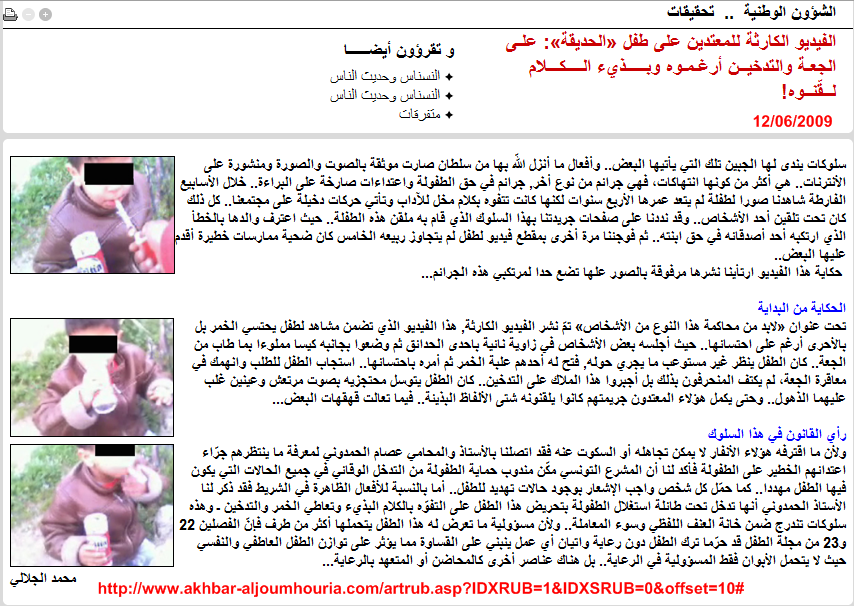
كنت في تدوينة سابقة بعنوان "طفولة في خطر... مستقبل بلد في خطر" عرضت مقطع فيديو انتشر في الآونة الأخيرة بشكل كبير على الفايسبوك يقوم فيه بعض الأشخاص بتقديم الخمر والتبغ لطفل يبلغ بالكاد ال
رّابعة من عمره. كتبت صحيفة أخبار الجمهورية -اليوم 12 جوان 2009- مقالا حول هذا الموضوع بعنوان "الفيديو الكارثة للمعتدين على طفل «الحديقة»: علـى الجعـة والتدخيــن أرغـمـوه وبـــــذيء الــــكـــلام لــقّنــوه!". كتب هذا المقال الصحفي محمّد الجلالي. ورغم سطحيّة المقال وضحالته إلاّ أنّني أنقله عسى أن يكون فاتحة لنقاش إعلامي جدّي حول موضوع الأخطار التي يواجهها قطاع واسع من الطفولة في بلادنا.

الفيديو الكارثة للمعتدين على طفل «الحديقة»: علـى الجعـة والتدخيــن أرغـمـوه وبـــــذيء الــــكـــلام لــقّنــوه!

كان الطفل يتجرع الجعة بصعوبة كبرى بينما كان أحد محتجزيه يقول له: «أشرب أشرب عندك كيس كامل من البيرة».سلوكات يندى لها الجبين تلك التي يأتيها البعض.. وأفعال ما أنزل اللّه بها من سلطان صارت موثقة بالصوت والصورة ومنشورة على الأنترنات.. هي أكثر من كونها انتهاكات، فهي جرائم من نوع أخر, جرائم في حق الطفولة واعتداءات صارخة على البراءة.. خلال الأسابيع الفارطة شاهدنا صورا لطفلة لم يتعد عمرها الأربع سنوات لكنها كانت تتفوه بكلام مخل للآداب وتأتي حركات دخيلة على مجتمعنا.. كل ذلك كان تحت تلقين أحد الأشخاص.. وقد نددنا على صفحات جريدتنا بهذا السلوك الذي قام به ملقن هذه الطفلة.. حيث اعترف والدها بالخطأ الذي ارتكبه أحد أصدقائه في حق ابنته.. ثم فوجئنا مرة أخرى بمقطع فيديو لطفل لم يتجاوز ربيعه الخامس كان ضحية ممارسات خطيرة أقدم عليها البعض..
حكاية هذا الفيديو ارتأينا نشرها مرفوقة بالصور علها تضع حدا لمرتكبي هذه الجرائم...

الحكاية من البداية

الطفل بسيجارة في يد وعلبة الجعة في اليد الأخرى.. يتوسل محتجزيه للتوقف عن الشرب لكنهم يأمرونه بمواصلة معاقرة الجعة ثم التدخين.. يتدخل أحدهم قائلا: «قارورة الجعة»تحت عنوان «لابد من محاكمة هذا النوع من الأشخاص» تمّ نشر الفيديو الكارثة, هذا الفيديو الذي تضمن مشاهد لطفل يحتسي الخمر بل بالأحرى أرغم على احتسائها.. حيث أجلسه بعض الأشخاص في زاوية نائية باحدى الحدائق ثم وضعوا بجانبه كيسا مملوءا بما طاب من الجعة.. كان الطفل ينظر غير مستوعب ما يجري حوله, فتح له أحدهم علبة الخمر ثم أمره باحتسائها.. استجاب الطفل للطلب وانهمك في معاقرة الجعة، لم يكتف المنحرفون بذلك بل أجبروا هذا الملاك على التدخين.. كان الطفل يتوسل محتجزيه بصوت مرتعش وعينين غلب عليهما الذهول.. وحتى يكمل هؤلاء المعتدون جريمتهم كانوا يلقنونه شتى الألفاظ البذيئة.. فيما تعالت قهقهات البعض...

رأي القانون في هذا السلوك
تمتد يد أحد الموجودين لتضع سيجارة بين شفتي الطفل.. ثم تقوم باشعال السيجارة.. يعجز الطفل عن التنفس.. فيقوم أحدهم باشعالها ثم يمدها له وسط قهقهات متتالية..ولأن ما اقترفه هؤلاء الأنفار لا يمكن تجاهله أو السكوت عنه فقد اتصلنا بالأستاذ والمحامي عصام الحمدوني لمعرفة ما ينتظرهم جرّاء اعتدائهم الخطير على الطفولة فأكد لنا أن المشرع التونسي مكّن مندوب حماية الطفولة من التدخل الوقائي في جميع الحالات التي يكون فيها الطفل مهددا.. كما حمّل كل شخص واجب الإشعار بوجود حالات تهديد للطفل.. أما بالنسبة للأفعال الظاهرة في الشريط فقد ذكر لنا الأستاذ الحمدوني أنها تدخل تحت طائلة استغلال الطفولة بتحريض هذا الطفل على التفوّه بالكلام البذيء وتعاطي الخمر والتدخين ـ وهذه سلوكات تندرج ضمن خانة العنف اللفظي وسوء المعاملة.. ولأن مسؤولية ما تعرض له هذا الطفل يتحملها أكثر من طرف فإنّ الفصلين 22 و23 من مجلة الطفل قد حرّما ترك الطفل دون رعاية واتيان أي عمل ينبني على القساوة مما يؤثر على توازن الطفل العاطفي والنفسي حيث لا يتحمل الأبوان فقط المسؤولية في الرعاية.. بل هناك عناصر أخرى كالمحاضن أو المتعهد بالرعاية...
محمّد الجلالي
المصدر
أرشيف

ومن جهتنا نشكر صحيفة أخبار الجمهورية على هذه اللفتة الكريمة والعناية الموصولة ونثمّن تنازلها عن ربع صفحة كان بإمكانها استغلالها في الإعلان للدجّالين والمشعوذين أو كشف الخونة وتعرية أعداء الوطن من الزنادقة والمارقين. وإنّنا إذ نشيد بهذه المبادرة اللطيفة التي تندرج في إطار رؤية شاملة ومقاربة استشرافية لموضوع الطفولة في تونس وتسعى لتكريس مبادىء فلسفة حماية الطفل وحقوقه من خلال منظومة حقوق الإنسان المتكاملة التي يتمتّع بها الإنسان التونسي منذ عقود طويلة، فإنّنا نرى -وربما نكون على خطأ والله أعلم- أنّ المزيد من المجهود الإعلامي لا يزال مطلوبا للتناول الجدّي لهذا الموضوع. ونهيب بهذه المناسبة بكل وسائل الإعلام التونسية الصفراء والبيضاء والزرقاء وحتى القزورديّة بأخذ المثال على صحيفة أخبار الجمهورية التي تمكّنت "وبشجاعة غير مسبوقة من تناول موضوع من أمّهات التابوهات" في تونس فألف شكر لها ولكل العاملين فيها من صحفيّين وتقنيّين ومحرّرين ومحلّلين ومديرين وعملة وناسخين وطابعين وساحبين وحرّاس وحتى منظّفين .. والتوسّعية من التوسّع والإمبرياليّة من الأمبرة والسلام عليكم ورحمة الله وبركاته.

إقرأ المزيد...
كتبت هذا النص: عبرات، ألم و أمل في الجمعة، يونيو 12، 2009


video

الجزء الأوّل (التحميل هنا)


video

الجزء الثاني (التحميل هنا)


video

الجزء الثالث (التحميل هنا)

نشر الباحثان الأمريكيان جون مارشيمر (John Mearsheimer) وستيفان والت (Stephen Walt) بحثا حول تأثير اللّوبي الصهيوني على الولايات المتّحدة ومصالحها. نشر هذا البحث على موقع جامعة هارفرد الأمريكية هنا. ونشرا أيضا مقالا صحفيا حول الموضوع بعنوان "اللّوبي الإسرائيلي". صدر هذا المقال بتاريخ 23 مارس 2006 في صحيفة لندن ريفيو أوف بوكس (London Review of Books).
The Israel Lobby
John Mearsheimer and Stephen Walt
March 23, 2006 - London Review of Books

For the past several decades, and especially since the Six-Day War in 1967, the centrepiece of US Middle Eastern policy has been its relationship with Israel. The combination of unwavering support for Israel and the related effort to spread ‘democracy’ throughout the region has inflamed Arab and Islamic opinion and jeopardised not only US security but that of much of the rest of the world. This situation has no equal in American political history. Why has the US been willing to set aside its own security and that of many of its allies in order to advance the interests of another state? One might assume that the bond between the two countries was based on shared strategic interests or compelling moral imperatives, but neither explanation can account for the remarkable level of material and diplomatic support that the US provides.

Instead, the thrust of US policy in the region derives almost entirely from domestic politics, and especially the activities of the ‘Israel Lobby’. Other special-interest groups have managed to skew foreign policy, but no lobby has managed to divert it as far from what the national interest would suggest, while simultaneously convincing Americans that US interests and those of the other country – in this case, Israel – are essentially identical.

Since the October War in 1973, Washington has provided Israel with a level of support dwarfing that given to any other state. It has been the largest annual recipient of direct economic and military assistance since 1976, and is the largest recipient in total since World War Two, to the tune of well over $140 billion (in 2004 dollars). Israel receives about $3 billion in direct assistance each year, roughly one-fifth of the foreign aid budget, and worth about $500 a year for every Israeli. This largesse is especially striking since Israel is now a wealthy industrial state with a per capita income roughly equal to that of South Korea or Spain.

Other recipients get their money in quarterly installments, but Israel receives its entire appropriation at the beginning of each fiscal year and can thus earn interest on it. Most recipients of aid given for military purposes are required to spend all of it in the US, but Israel is allowed to use roughly 25 per cent of its allocation to subsidise its own defence industry. It is the only recipient that does not have to account for how the aid is spent, which makes it virtually impossible to prevent the money from being used for purposes the US opposes, such as building settlements on the West Bank. Moreover, the US has provided Israel with nearly $3 billion to develop weapons systems, and given it access to such top-drawer weaponry as Blackhawk helicopters and F-16 jets. Finally, the US gives Israel access to intelligence it denies to its Nato allies and has turned a blind eye to Israel’s acquisition of nuclear weapons.

Washington also provides Israel with consistent diplomatic support. Since 1982, the US has vetoed 32 Security Council resolutions critical of Israel, more than the total number of vetoes cast by all the other Security Council members. It blocks the efforts of Arab states to put Israel’s nuclear arsenal on the IAEA’s agenda. The US comes to the rescue in wartime and takes Israel’s side when negotiating peace. The Nixon administration protected it from the threat of Soviet intervention and resupplied it during the October War. Washington was deeply involved in the negotiations that ended that war, as well as in the lengthy ‘step-by-step’ process that followed, just as it played a key role in the negotiations that preceded and followed the 1993 Oslo Accords. In each case there was occasional friction between US and Israeli officials, but the US consistently supported the Israeli position. One American participant at Camp David in 2000 later said: ‘Far too often, we functioned . . . as Israel’s lawyer.’ Finally, the Bush administration’s ambition to transform the Middle East is at least partly aimed at improving Israel’s strategic situation.

This extraordinary generosity might be understandable if Israel were a vital strategic asset or if there were a compelling moral case for US backing. But neither explanation is convincing. One might argue that Israel was an asset during the Cold War. By serving as America’s proxy after 1967, it helped contain Soviet expansion in the region and inflicted humiliating defeats on Soviet clients like Egypt and Syria. It occasionally helped protect other US allies (like King Hussein of Jordan) and its military prowess forced Moscow to spend more on backing its own client states. It also provided useful intelligence about Soviet capabilities.

Backing Israel was not cheap, however, and it complicated America’s relations with the Arab world. For example, the decision to give $2.2 billion in emergency military aid during the October War triggered an Opec oil embargo that inflicted considerable damage on Western economies. For all that, Israel’s armed forces were not in a position to protect US interests in the region. The US could not, for example, rely on Israel when the Iranian Revolution in 1979 raised concerns about the security of oil supplies, and had to create its own Rapid Deployment Force instead.

The first Gulf War revealed the extent to which Israel was becoming a strategic burden. The US could not use Israeli bases without rupturing the anti-Iraq coalition, and had to divert resources (e.g. Patriot missile batteries) to prevent Tel Aviv doing anything that might harm the alliance against Saddam Hussein. History repeated itself in 2003: although Israel was eager for the US to attack Iraq, Bush could not ask it to help without triggering Arab opposition. So Israel stayed on the sidelines once again.

Beginning in the 1990s, and even more after 9/11, US support has been justified by the claim that both states are threatened by terrorist groups originating in the Arab and Muslim world, and by ‘rogue states’ that back these groups and seek weapons of mass destruction. This is taken to mean not only that Washington should give Israel a free hand in dealing with the Palestinians and not press it to make concessions until all Palestinian terrorists are imprisoned or dead, but that the US should go after countries like Iran and Syria. Israel is thus seen as a crucial ally in the war on terror, because its enemies are America’s enemies. In fact, Israel is a liability in the war on terror and the broader effort to deal with rogue states.

‘Terrorism’ is not a single adversary, but a tactic employed by a wide array of political groups. The terrorist organisations that threaten Israel do not threaten the United States, except when it intervenes against them (as in Lebanon in 1982). Moreover, Palestinian terrorism is not random violence directed against Israel or ‘the West’; it is largely a response to Israel’s prolonged campaign to colonise the West Bank and Gaza Strip.

More important, saying that Israel and the US are united by a shared terrorist threat has the causal relationship backwards: the US has a terrorism problem in good part because it is so closely allied with Israel, not the other way around. Support for Israel is not the only source of anti-American terrorism, but it is an important one, and it makes winning the war on terror more difficult. There is no question that many al-Qaida leaders, including Osama bin Laden, are motivated by Israel’s presence in Jerusalem and the plight of the Palestinians. Unconditional support for Israel makes it easier for extremists to rally popular support and to attract recruits.

As for so-called rogue states in the Middle East, they are not a dire threat to vital US interests, except inasmuch as they are a threat to Israel. Even if these states acquire nuclear weapons – which is obviously undesirable – neither America nor Israel could be blackmailed, because the blackmailer could not carry out the threat without suffering overwhelming retaliation. The danger of a nuclear handover to terrorists is equally remote, because a rogue state could not be sure the transfer would go undetected or that it would not be blamed and punished afterwards. The relationship with Israel actually makes it harder for the US to deal with these states. Israel’s nuclear arsenal is one reason some of its neighbours want nuclear weapons, and threatening them with regime change merely increases that desire.

A final reason to question Israel’s strategic value is that it does not behave like a loyal ally. Israeli officials frequently ignore US requests and renege on promises (including pledges to stop building settlements and to refrain from ‘targeted assassinations’ of Palestinian leaders). Israel has provided sensitive military technology to potential rivals like China, in what the State Department inspector-general called ‘a systematic and growing pattern of unauthorised transfers’. According to the General Accounting Office, Israel also ‘conducts the most aggressive espionage operations against the US of any ally’. In addition to the case of Jonathan Pollard, who gave Israel large quantities of classified material in the early 1980s (which it reportedly passed on to the Soviet Union in return for more exit visas for Soviet Jews), a new controversy erupted in 2004 when it was revealed that a key Pentagon official called Larry Franklin had passed classified information to an Israeli diplomat. Israel is hardly the only country that spies on the US, but its willingness to spy on its principal patron casts further doubt on its strategic value.

Israel’s strategic value isn’t the only issue. Its backers also argue that it deserves unqualified support because it is weak and surrounded by enemies; it is a democracy; the Jewish people have suffered from past crimes and therefore deserve special treatment; and Israel’s conduct has been morally superior to that of its adversaries. On close inspection, none of these arguments is persuasive. There is a strong moral case for supporting Israel’s existence, but that is not in jeopardy. Viewed objectively, its past and present conduct offers no moral basis for privileging it over the Palestinians.

Israel is often portrayed as David confronted by Goliath, but the converse is closer to the truth. Contrary to popular belief, the Zionists had larger, better equipped and better led forces during the 1947-49 War of Independence, and the Israel Defence Forces won quick and easy victories against Egypt in 1956 and against Egypt, Jordan and Syria in 1967 – all of this before large-scale US aid began flowing. Today, Israel is the strongest military power in the Middle East. Its conventional forces are far superior to those of its neighbours and it is the only state in the region with nuclear weapons. Egypt and Jordan have signed peace treaties with it, and Saudi Arabia has offered to do so. Syria has lost its Soviet patron, Iraq has been devastated by three disastrous wars and Iran is hundreds of miles away. The Palestinians barely have an effective police force, let alone an army that could pose a threat to Israel. According to a 2005 assessment by Tel Aviv University’s Jaffee Centre for Strategic Studies, ‘the strategic balance decidedly favours Israel, which has continued to widen the qualitative gap between its own military capability and deterrence powers and those of its neighbours.’ If backing the underdog were a compelling motive, the United States would be supporting Israel’s opponents.

That Israel is a fellow democracy surrounded by hostile dictatorships cannot account for the current level of aid: there are many democracies around the world, but none receives the same lavish support. The US has overthrown democratic governments in the past and supported dictators when this was thought to advance its interests – it has good relations with a number of dictatorships today.

Some aspects of Israeli democracy are at odds with core American values. Unlike the US, where people are supposed to enjoy equal rights irrespective of race, religion or ethnicity, Israel was explicitly founded as a Jewish state and citizenship is based on the principle of blood kinship. Given this, it is not surprising that its 1.3 million Arabs are treated as second-class citizens, or that a recent Israeli government commission found that Israel behaves in a ‘neglectful and discriminatory’ manner towards them. Its democratic status is also undermined by its refusal to grant the Palestinians a viable state of their own or full political rights.

A third justification is the history of Jewish suffering in the Christian West, especially during the Holocaust. Because Jews were persecuted for centuries and could feel safe only in a Jewish homeland, many people now believe that Israel deserves special treatment from the United States. The country’s creation was undoubtedly an appropriate response to the long record of crimes against Jews, but it also brought about fresh crimes against a largely innocent third party: the Palestinians.

This was well understood by Israel’s early leaders. David Ben-Gurion told Nahum Goldmann, the president of the World Jewish Congress:

If I were an Arab leader I would never make terms with Israel. That is natural: we have taken their country . . . We come from Israel, but two thousand years ago, and what is that to them? There has been anti-semitism, the Nazis, Hitler, Auschwitz, but was that their fault? They only see one thing: we have come here and stolen their country. Why should they accept that?

Since then, Israeli leaders have repeatedly sought to deny the Palestinians’ national ambitions. When she was prime minister, Golda Meir famously remarked that ‘there is no such thing as a Palestinian.’ Pressure from extremist violence and Palestinian population growth has forced subsequent Israeli leaders to disengage from the Gaza Strip and consider other territorial compromises, but not even Yitzhak Rabin was willing to offer the Palestinians a viable state. Ehud Barak’s purportedly generous offer at Camp David would have given them only a disarmed set of Bantustans under de facto Israeli control. The tragic history of the Jewish people does not obligate the US to help Israel today no matter what it does.

Israel’s backers also portray it as a country that has sought peace at every turn and shown great restraint even when provoked. The Arabs, by contrast, are said to have acted with great wickedness. Yet on the ground, Israel’s record is not distinguishable from that of its opponents. Ben-Gurion acknowledged that the early Zionists were far from benevolent towards the Palestinian Arabs, who resisted their encroachments – which is hardly surprising, given that the Zionists were trying to create their own state on Arab land. In the same way, the creation of Israel in 1947-48 involved acts of ethnic cleansing, including executions, massacres and rapes by Jews, and Israel’s subsequent conduct has often been brutal, belying any claim to moral superiority. Between 1949 and 1956, for example, Israeli security forces killed between 2700 and 5000 Arab infiltrators, the overwhelming majority of them unarmed. The IDF murdered hundreds of Egyptian prisoners of war in both the 1956 and 1967 wars, while in 1967, it expelled between 100,000 and 260,000 Palestinians from the newly conquered West Bank, and drove 80,000 Syrians from the Golan Heights.

During the first intifada, the IDF distributed truncheons to its troops and encouraged them to break the bones of Palestinian protesters. The Swedish branch of Save the Children estimated that ‘23,600 to 29,900 children required medical treatment for their beating injuries in the first two years of the intifada.’ Nearly a third of them were aged ten or under. The response to the second intifada has been even more violent, leading Ha’aretz to declare that ‘the IDF . . . is turning into a killing machine whose efficiency is awe-inspiring, yet shocking.’ The IDF fired one million bullets in the first days of the uprising. Since then, for every Israeli lost, Israel has killed 3.4 Palestinians, the majority of whom have been innocent bystanders; the ratio of Palestinian to Israeli children killed is even higher (5.7:1). It is also worth bearing in mind that the Zionists relied on terrorist bombs to drive the British from Palestine, and that Yitzhak Shamir, once a terrorist and later prime minister, declared that ‘neither Jewish ethics nor Jewish tradition can disqualify terrorism as a means of combat.’

The Palestinian resort to terrorism is wrong but it isn’t surprising. The Palestinians believe they have no other way to force Israeli concessions. As Ehud Barak once admitted, had he been born a Palestinian, he ‘would have joined a terrorist organisation’.

So if neither strategic nor moral arguments can account for America’s support for Israel, how are we to explain it?

The explanation is the unmatched power of the Israel Lobby. We use ‘the Lobby’ as shorthand for the loose coalition of individuals and organisations who actively work to steer US foreign policy in a pro-Israel direction. This is not meant to suggest that ‘the Lobby’ is a unified movement with a central leadership, or that individuals within it do not disagree on certain issues. Not all Jewish Americans are part of the Lobby, because Israel is not a salient issue for many of them. In a 2004 survey, for example, roughly 36 per cent of American Jews said they were either ‘not very’ or ‘not at all’ emotionally attached to Israel.

Jewish Americans also differ on specific Israeli policies. Many of the key organisations in the Lobby, such as the American-Israel Public Affairs Committee (AIPAC) and the Conference of Presidents of Major Jewish Organisations, are run by hardliners who generally support the Likud Party’s expansionist policies, including its hostility to the Oslo peace process. The bulk of US Jewry, meanwhile, is more inclined to make concessions to the Palestinians, and a few groups – such as Jewish Voice for Peace – strongly advocate such steps. Despite these differences, moderates and hardliners both favour giving steadfast support to Israel.

Not surprisingly, American Jewish leaders often consult Israeli officials, to make sure that their actions advance Israeli goals. As one activist from a major Jewish organisation wrote, ‘it is routine for us to say: “This is our policy on a certain issue, but we must check what the Israelis think.” We as a community do it all the time.’ There is a strong prejudice against criticising Israeli policy, and putting pressure on Israel is considered out of order. Edgar Bronfman Sr, the president of the World Jewish Congress, was accused of ‘perfidy’ when he wrote a letter to President Bush in mid-2003 urging him to persuade Israel to curb construction of its controversial ‘security fence’. His critics said that ‘it would be obscene at any time for the president of the World Jewish Congress to lobby the president of the United States to resist policies being promoted by the government of Israel.’

Similarly, when the president of the Israel Policy Forum, Seymour Reich, advised Condoleezza Rice in November 2005 to ask Israel to reopen a critical border crossing in the Gaza Strip, his action was denounced as ‘irresponsible’: ‘There is,’ his critics said, ‘absolutely no room in the Jewish mainstream for actively canvassing against the security-related policies . . . of Israel.’ Recoiling from these attacks, Reich announced that ‘the word “pressure” is not in my vocabulary when it comes to Israel.’

Jewish Americans have set up an impressive array of organisations to influence American foreign policy, of which AIPAC is the most powerful and best known. In 1997, Fortune magazine asked members of Congress and their staffs to list the most powerful lobbies in Washington. AIPAC was ranked second behind the American Association of Retired People, but ahead of the AFL-CIO and the National Rifle Association. A National Journal study in March 2005 reached a similar conclusion, placing AIPAC in second place (tied with AARP) in the Washington ‘muscle rankings’.

The Lobby also includes prominent Christian evangelicals like Gary Bauer, Jerry Falwell, Ralph Reed and Pat Robertson, as well as Dick Armey and Tom DeLay, former majority leaders in the House of Representatives, all of whom believe Israel’s rebirth is the fulfilment of biblical prophecy and support its expansionist agenda; to do otherwise, they believe, would be contrary to God’s will. Neo-conservative gentiles such as John Bolton; Robert Bartley, the former Wall Street Journal editor; William Bennett, the former secretary of education; Jeane Kirkpatrick, the former UN ambassador; and the influential columnist George Will are also steadfast supporters.

The US form of government offers activists many ways of influencing the policy process. Interest groups can lobby elected representatives and members of the executive branch, make campaign contributions, vote in elections, try to mould public opinion etc. They enjoy a disproportionate amount of influence when they are committed to an issue to which the bulk of the population is indifferent. Policymakers will tend to accommodate those who care about the issue, even if their numbers are small, confident that the rest of the population will not penalise them for doing so.

In its basic operations, the Israel Lobby is no different from the farm lobby, steel or textile workers’ unions, or other ethnic lobbies. There is nothing improper about American Jews and their Christian allies attempting to sway US policy: the Lobby’s activities are not a conspiracy of the sort depicted in tracts like the Protocols of the Elders of Zion. For the most part, the individuals and groups that comprise it are only doing what other special interest groups do, but doing it very much better. By contrast, pro-Arab interest groups, in so far as they exist at all, are weak, which makes the Israel Lobby’s task even easier.

The Lobby pursues two broad strategies. First, it wields its significant influence in Washington, pressuring both Congress and the executive branch. Whatever an individual lawmaker or policymaker’s own views may be, the Lobby tries to make supporting Israel the ‘smart’ choice. Second, it strives to ensure that public discourse portrays Israel in a positive light, by repeating myths about its founding and by promoting its point of view in policy debates. The goal is to prevent critical comments from getting a fair hearing in the political arena. Controlling the debate is essential to guaranteeing US support, because a candid discussion of US-Israeli relations might lead Americans to favour a different policy.

A key pillar of the Lobby’s effectiveness is its influence in Congress, where Israel is virtually immune from criticism. This in itself is remarkable, because Congress rarely shies away from contentious issues. Where Israel is concerned, however, potential critics fall silent. One reason is that some key members are Christian Zionists like Dick Armey, who said in September 2002: ‘My No. 1 priority in foreign policy is to protect Israel.’ One might think that the No. 1 priority for any congressman would be to protect America. There are also Jewish senators and congressmen who work to ensure that US foreign policy supports Israel’s interests.

Another source of the Lobby’s power is its use of pro-Israel congressional staffers. As Morris Amitay, a former head of AIPAC, once admitted, ‘there are a lot of guys at the working level up here’ – on Capitol Hill – ‘who happen to be Jewish, who are willing . . . to look at certain issues in terms of their Jewishness . . . These are all guys who are in a position to make the decision in these areas for those senators . . . You can get an awful lot done just at the staff level.’

AIPAC itself, however, forms the core of the Lobby’s influence in Congress. Its success is due to its ability to reward legislators and congressional candidates who support its agenda, and to punish those who challenge it. Money is critical to US elections (as the scandal over the lobbyist Jack Abramoff’s shady dealings reminds us), and AIPAC makes sure that its friends get strong financial support from the many pro-Israel political action committees. Anyone who is seen as hostile to Israel can be sure that AIPAC will direct campaign contributions to his or her political opponents. AIPAC also organises letter-writing campaigns and encourages newspaper editors to endorse pro-Israel candidates.

There is no doubt about the efficacy of these tactics. Here is one example: in the 1984 elections, AIPAC helped defeat Senator Charles Percy from Illinois, who, according to a prominent Lobby figure, had ‘displayed insensitivity and even hostility to our concerns’. Thomas Dine, the head of AIPAC at the time, explained what happened: ‘All the Jews in America, from coast to coast, gathered to oust Percy. And the American politicians – those who hold public positions now, and those who aspire – got the message.’

AIPAC’s influence on Capitol Hill goes even further. According to Douglas Bloomfield, a former AIPAC staff member, ‘it is common for members of Congress and their staffs to turn to AIPAC first when they need information, before calling the Library of Congress, the Congressional Research Service, committee staff or administration experts.’ More important, he notes that AIPAC is ‘often called on to draft speeches, work on legislation, advise on tactics, perform research, collect co-sponsors and marshal votes’.

The bottom line is that AIPAC, a de facto agent for a foreign government, has a stranglehold on Congress, with the result that US policy towards Israel is not debated there, even though that policy has important consequences for the entire world. In other words, one of the three main branches of the government is firmly committed to supporting Israel. As one former Democratic senator, Ernest Hollings, noted on leaving office, ‘you can’t have an Israeli policy other than what AIPAC gives you around here.’ Or as Ariel Sharon once told an American audience, ‘when people ask me how they can help Israel, I tell them: “Help AIPAC.”’

Thanks in part to the influence Jewish voters have on presidential elections, the Lobby also has significant leverage over the executive branch. Although they make up fewer than 3 per cent of the population, they make large campaign donations to candidates from both parties. The Washington Post once estimated that Democratic presidential candidates ‘depend on Jewish supporters to supply as much as 60 per cent of the money’. And because Jewish voters have high turn-out rates and are concentrated in key states like California, Florida, Illinois, New York and Pennsylvania, presidential candidates go to great lengths not to antagonise them.

Key organisations in the Lobby make it their business to ensure that critics of Israel do not get important foreign policy jobs. Jimmy Carter wanted to make George Ball his first secretary of state, but knew that Ball was seen as critical of Israel and that the Lobby would oppose the appointment. In this way any aspiring policymaker is encouraged to become an overt supporter of Israel, which is why public critics of Israeli policy have become an endangered species in the foreign policy establishment.

When Howard Dean called for the United States to take a more ‘even-handed role’ in the Arab-Israeli conflict, Senator Joseph Lieberman accused him of selling Israel down the river and said his statement was ‘irresponsible’. Virtually all the top Democrats in the House signed a letter criticising Dean’s remarks, and the Chicago Jewish Star reported that ‘anonymous attackers . . . are clogging the email inboxes of Jewish leaders around the country, warning – without much evidence – that Dean would somehow be bad for Israel.’

This worry was absurd; Dean is in fact quite hawkish on Israel: his campaign co-chair was a former AIPAC president, and Dean said his own views on the Middle East more closely reflected those of AIPAC than those of the more moderate Americans for Peace Now. He had merely suggested that to ‘bring the sides together’, Washington should act as an honest broker. This is hardly a radical idea, but the Lobby doesn’t tolerate even-handedness.

During the Clinton administration, Middle Eastern policy was largely shaped by officials with close ties to Israel or to prominent pro-Israel organisations; among them, Martin Indyk, the former deputy director of research at AIPAC and co-founder of the pro-Israel Washington Institute for Near East Policy (WINEP); Dennis Ross, who joined WINEP after leaving government in 2001; and Aaron Miller, who has lived in Israel and often visits the country. These men were among Clinton’s closest advisers at the Camp David summit in July 2000. Although all three supported the Oslo peace process and favoured the creation of a Palestinian state, they did so only within the limits of what would be acceptable to Israel. The American delegation took its cues from Ehud Barak, co-ordinated its negotiating positions with Israel in advance, and did not offer independent proposals. Not surprisingly, Palestinian negotiators complained that they were ‘negotiating with two Israeli teams – one displaying an Israeli flag, and one an American flag’.

The situation is even more pronounced in the Bush administration, whose ranks have included such fervent advocates of the Israeli cause as Elliot Abrams, John Bolton, Douglas Feith, I. Lewis (‘Scooter’) Libby, Richard Perle, Paul Wolfowitz and David Wurmser. As we shall see, these officials have consistently pushed for policies favoured by Israel and backed by organisations in the Lobby.

The Lobby doesn’t want an open debate, of course, because that might lead Americans to question the level of support they provide. Accordingly, pro-Israel organisations work hard to influence the institutions that do most to shape popular opinion.

The Lobby’s perspective prevails in the mainstream media: the debate among Middle East pundits, the journalist Eric Alterman writes, is ‘dominated by people who cannot imagine criticising Israel’. He lists 61 ‘columnists and commentators who can be counted on to support Israel reflexively and without qualification’. Conversely, he found just five pundits who consistently criticise Israeli actions or endorse Arab positions. Newspapers occasionally publish guest op-eds challenging Israeli policy, but the balance of opinion clearly favours the other side. It is hard to imagine any mainstream media outlet in the United States publishing a piece like this one.

‘Shamir, Sharon, Bibi – whatever those guys want is pretty much fine by me,’ Robert Bartley once remarked. Not surprisingly, his newspaper, the Wall Street Journal, along with other prominent papers like the Chicago Sun-Times and the Washington Times, regularly runs editorials that strongly support Israel. Magazines like Commentary, the New Republic and the Weekly Standard defend Israel at every turn.

Editorial bias is also found in papers like the New York Times, which occasionally criticises Israeli policies and sometimes concedes that the Palestinians have legitimate grievances, but is not even-handed. In his memoirs the paper’s former executive editor Max Frankel acknowledges the impact his own attitude had on his editorial decisions: ‘I was much more deeply devoted to Israel than I dared to assert . . . Fortified by my knowledge of Israel and my friendships there, I myself wrote most of our Middle East commentaries. As more Arab than Jewish readers recognised, I wrote them from a pro-Israel perspective.’

News reports are more even-handed, in part because reporters strive to be objective, but also because it is difficult to cover events in the Occupied Territories without acknowledging Israel’s actions on the ground. To discourage unfavourable reporting, the Lobby organises letter-writing campaigns, demonstrations and boycotts of news outlets whose content it considers anti-Israel. One CNN executive has said that he sometimes gets 6000 email messages in a single day complaining about a story. In May 2003, the pro-Israel Committee for Accurate Middle East Reporting in America (CAMERA) organised demonstrations outside National Public Radio stations in 33 cities; it also tried to persuade contributors to withhold support from NPR until its Middle East coverage becomes more sympathetic to Israel. Boston’s NPR station, WBUR, reportedly lost more than $1 million in contributions as a result of these efforts. Further pressure on NPR has come from Israel’s friends in Congress, who have asked for an internal audit of its Middle East coverage as well as more oversight.

The Israeli side also dominates the think tanks which play an important role in shaping public debate as well as actual policy. The Lobby created its own think tank in 1985, when Martin Indyk helped to found WINEP. Although WINEP plays down its links to Israel, claiming instead to provide a ‘balanced and realistic’ perspective on Middle East issues, it is funded and run by individuals deeply committed to advancing Israel’s agenda.

The Lobby’s influence extends well beyond WINEP, however. Over the past 25 years, pro-Israel forces have established a commanding presence at the American Enterprise Institute, the Brookings Institution, the Center for Security Policy, the Foreign Policy Research Institute, the Heritage Foundation, the Hudson Institute, the Institute for Foreign Policy Analysis and the Jewish Institute for National Security Affairs (JINSA). These think tanks employ few, if any, critics of US support for Israel.

Take the Brookings Institution. For many years, its senior expert on the Middle East was William Quandt, a former NSC official with a well-deserved reputation for even-handedness. Today, Brookings’s coverage is conducted through the Saban Center for Middle East Studies, which is financed by Haim Saban, an Israeli-American businessman and ardent Zionist. The centre’s director is the ubiquitous Martin Indyk. What was once a non-partisan policy institute is now part of the pro-Israel chorus.

Where the Lobby has had the most difficulty is in stifling debate on university campuses. In the 1990s, when the Oslo peace process was underway, there was only mild criticism of Israel, but it grew stronger with Oslo’s collapse and Sharon’s access to power, becoming quite vociferous when the IDF reoccupied the West Bank in spring 2002 and employed massive force to subdue the second intifada.

The Lobby moved immediately to ‘take back the campuses’. New groups sprang up, like the Caravan for Democracy, which brought Israeli speakers to US colleges. Established groups like the Jewish Council for Public Affairs and Hillel joined in, and a new group, the Israel on Campus Coalition, was formed to co-ordinate the many bodies that now sought to put Israel’s case. Finally, AIPAC more than tripled its spending on programmes to monitor university activities and to train young advocates, in order to ‘vastly expand the number of students involved on campus . . . in the national pro-Israel effort’.

The Lobby also monitors what professors write and teach. In September 2002, Martin Kramer and Daniel Pipes, two passionately pro-Israel neo-conservatives, established a website (Campus Watch) that posted dossiers on suspect academics and encouraged students to report remarks or behaviour that might be considered hostile to Israel. This transparent attempt to blacklist and intimidate scholars provoked a harsh reaction and Pipes and Kramer later removed the dossiers, but the website still invites students to report ‘anti-Israel’ activity.

Groups within the Lobby put pressure on particular academics and universities. Columbia has been a frequent target, no doubt because of the presence of the late Edward Said on its faculty. ‘One can be sure that any public statement in support of the Palestinian people by the pre-eminent literary critic Edward Said will elicit hundreds of emails, letters and journalistic accounts that call on us to denounce Said and to either sanction or fire him,’ Jonathan Cole, its former provost, reported. When Columbia recruited the historian Rashid Khalidi from Chicago, the same thing happened. It was a problem Princeton also faced a few years later when it considered wooing Khalidi away from Columbia.

A classic illustration of the effort to police academia occurred towards the end of 2004, when the David Project produced a film alleging that faculty members of Columbia’s Middle East Studies programme were anti-semitic and were intimidating Jewish students who stood up for Israel. Columbia was hauled over the coals, but a faculty committee which was assigned to investigate the charges found no evidence of anti-semitism and the only incident possibly worth noting was that one professor had ‘responded heatedly’ to a student’s question. The committee also discovered that the academics in question had themselves been the target of an overt campaign of intimidation.

Perhaps the most disturbing aspect of all this is the efforts Jewish groups have made to push Congress into establishing mechanisms to monitor what professors say. If they manage to get this passed, universities judged to have an anti-Israel bias would be denied federal funding. Their efforts have not yet succeeded, but they are an indication of the importance placed on controlling debate.

A number of Jewish philanthropists have recently established Israel Studies programmes (in addition to the roughly 130 Jewish Studies programmes already in existence) so as to increase the number of Israel-friendly scholars on campus. In May 2003, NYU announced the establishment of the Taub Center for Israel Studies; similar programmes have been set up at Berkeley, Brandeis and Emory. Academic administrators emphasise their pedagogical value, but the truth is that they are intended in large part to promote Israel’s image. Fred Laffer, the head of the Taub Foundation, makes it clear that his foundation funded the NYU centre to help counter the ‘Arabic [sic] point of view’ that he thinks is prevalent in NYU’s Middle East programmes.

No discussion of the Lobby would be complete without an examination of one of its most powerful weapons: the charge of anti-semitism. Anyone who criticises Israel’s actions or argues that pro-Israel groups have significant influence over US Middle Eastern policy – an influence AIPAC celebrates – stands a good chance of being labelled an anti-semite. Indeed, anyone who merely claims that there is an Israel Lobby runs the risk of being charged with anti-semitism, even though the Israeli media refer to America’s ‘Jewish Lobby’. In other words, the Lobby first boasts of its influence and then attacks anyone who calls attention to it. It’s a very effective tactic: anti-semitism is something no one wants to be accused of.

Europeans have been more willing than Americans to criticise Israeli policy, which some people attribute to a resurgence of anti-semitism in Europe. We are ‘getting to a point’, the US ambassador to the EU said in early 2004, ‘where it is as bad as it was in the 1930s’. Measuring anti-semitism is a complicated matter, but the weight of evidence points in the opposite direction. In the spring of 2004, when accusations of European anti-semitism filled the air in America, separate surveys of European public opinion conducted by the US-based Anti-Defamation League and the Pew Research Center for the People and the Press found that it was in fact declining. In the 1930s, by contrast, anti-semitism was not only widespread among Europeans of all classes but considered quite acceptable.

The Lobby and its friends often portray France as the most anti-semitic country in Europe. But in 2003, the head of the French Jewish community said that ‘France is not more anti-semitic than America.’ According to a recent article in Ha’aretz, the French police have reported that anti-semitic incidents declined by almost 50 per cent in 2005; and this even though France has the largest Muslim population of any European country. Finally, when a French Jew was murdered in Paris last month by a Muslim gang, tens of thousands of demonstrators poured into the streets to condemn anti-semitism. Jacques Chirac and Dominique de Villepin both attended the victim’s memorial service to show their solidarity.

No one would deny that there is anti-semitism among European Muslims, some of it provoked by Israel’s conduct towards the Palestinians and some of it straightforwardly racist. But this is a separate matter with little bearing on whether or not Europe today is like Europe in the 1930s. Nor would anyone deny that there are still some virulent autochthonous anti-semites in Europe (as there are in the United States) but their numbers are small and their views are rejected by the vast majority of Europeans.

Israel’s advocates, when pressed to go beyond mere assertion, claim that there is a ‘new anti-semitism’, which they equate with criticism of Israel. In other words, criticise Israeli policy and you are by definition an anti-semite. When the synod of the Church of England recently voted to divest from Caterpillar Inc on the grounds that it manufactures the bulldozers used by the Israelis to demolish Palestinian homes, the Chief Rabbi complained that this would ‘have the most adverse repercussions on . . . Jewish-Christian relations in Britain’, while Rabbi Tony Bayfield, the head of the Reform movement, said: ‘There is a clear problem of anti-Zionist – verging on anti-semitic – attitudes emerging in the grass-roots, and even in the middle ranks of the Church.’ But the Church was guilty merely of protesting against Israeli government policy.

Critics are also accused of holding Israel to an unfair standard or questioning its right to exist. But these are bogus charges too. Western critics of Israel hardly ever question its right to exist: they question its behaviour towards the Palestinians, as do Israelis themselves. Nor is Israel being judged unfairly. Israeli treatment of the Palestinians elicits criticism because it is contrary to widely accepted notions of human rights, to international law and to the principle of national self-determination. And it is hardly the only state that has faced sharp criticism on these grounds.

In the autumn of 2001, and especially in the spring of 2002, the Bush administration tried to reduce anti-American sentiment in the Arab world and undermine support for terrorist groups like al-Qaida by halting Israel’s expansionist policies in the Occupied Territories and advocating the creation of a Palestinian state. Bush had very significant means of persuasion at his disposal. He could have threatened to reduce economic and diplomatic support for Israel, and the American people would almost certainly have supported him. A May 2003 poll reported that more than 60 per cent of Americans were willing to withhold aid if Israel resisted US pressure to settle the conflict, and that number rose to 70 per cent among the ‘politically active’. Indeed, 73 per cent said that the United States should not favour either side.

Yet the administration failed to change Israeli policy, and Washington ended up backing it. Over time, the administration also adopted Israel’s own justifications of its position, so that US rhetoric began to mimic Israeli rhetoric. By February 2003, a Washington Post headline summarised the situation: ‘Bush and Sharon Nearly Identical on Mideast Policy.’ The main reason for this switch was the Lobby.

The story begins in late September 2001, when Bush began urging Sharon to show restraint in the Occupied Territories. He also pressed him to allow Israel’s foreign minister, Shimon Peres, to meet with Yasser Arafat, even though he (Bush) was highly critical of Arafat’s leadership. Bush even said publicly that he supported the creation of a Palestinian state. Alarmed, Sharon accused him of trying ‘to appease the Arabs at our expense’, warning that Israel ‘will not be Czechoslovakia’.

Bush was reportedly furious at being compared to Chamberlain, and the White House press secretary called Sharon’s remarks ‘unacceptable’. Sharon offered a pro forma apology, but quickly joined forces with the Lobby to persuade the administration and the American people that the United States and Israel faced a common threat from terrorism. Israeli officials and Lobby representatives insisted that there was no real difference between Arafat and Osama bin Laden: the United States and Israel, they said, should isolate the Palestinians’ elected leader and have nothing to do with him.

The Lobby also went to work in Congress. On 16 November, 89 senators sent Bush a letter praising him for refusing to meet with Arafat, but also demanding that the US not restrain Israel from retaliating against the Palestinians; the administration, they wrote, must state publicly that it stood behind Israel. According to the New York Times, the letter ‘stemmed’ from a meeting two weeks before between ‘leaders of the American Jewish community and key senators’, adding that AIPAC was ‘particularly active in providing advice on the letter’.

By late November, relations between Tel Aviv and Washington had improved considerably. This was thanks in part to the Lobby’s efforts, but also to America’s initial victory in Afghanistan, which reduced the perceived need for Arab support in dealing with al-Qaida. Sharon visited the White House in early December and had a friendly meeting with Bush.

In April 2002 trouble erupted again, after the IDF launched Operation Defensive Shield and resumed control of virtually all the major Palestinian areas on the West Bank. Bush knew that Israel’s actions would damage America’s image in the Islamic world and undermine the war on terrorism, so he demanded that Sharon ‘halt the incursions and begin withdrawal’. He underscored this message two days later, saying he wanted Israel to ‘withdraw without delay’. On 7 April, Condoleezza Rice, then Bush’s national security adviser, told reporters: ‘“Without delay” means without delay. It means now.’ That same day Colin Powell set out for the Middle East to persuade all sides to stop fighting and start negotiating.

Israel and the Lobby swung into action. Pro-Israel officials in the vice-president’s office and the Pentagon, as well as neo-conservative pundits like Robert Kagan and William Kristol, put the heat on Powell. They even accused him of having ‘virtually obliterated the distinction between terrorists and those fighting terrorists’. Bush himself was being pressed by Jewish leaders and Christian evangelicals. Tom DeLay and Dick Armey were especially outspoken about the need to support Israel, and DeLay and the Senate minority leader, Trent Lott, visited the White House and warned Bush to back off.

The first sign that Bush was caving in came on 11 April – a week after he told Sharon to withdraw his forces – when the White House press secretary said that the president believed Sharon was ‘a man of peace’. Bush repeated this statement publicly on Powell’s return from his abortive mission, and told reporters that Sharon had responded satisfactorily to his call for a full and immediate withdrawal. Sharon had done no such thing, but Bush was no longer willing to make an issue of it.

Meanwhile, Congress was also moving to back Sharon. On 2 May, it overrode the administration’s objections and passed two resolutions reaffirming support for Israel. (The Senate vote was 94 to 2; the House of Representatives version passed 352 to 21.) Both resolutions held that the United States ‘stands in solidarity with Israel’ and that the two countries were, to quote the House resolution, ‘now engaged in a common struggle against terrorism’. The House version also condemned ‘the ongoing support and co-ordination of terror by Yasser Arafat’, who was portrayed as a central part of the terrorism problem. Both resolutions were drawn up with the help of the Lobby. A few days later, a bipartisan congressional delegation on a fact-finding mission to Israel stated that Sharon should resist US pressure to negotiate with Arafat. On 9 May, a House appropriations subcommittee met to consider giving Israel an extra $200 million to fight terrorism. Powell opposed the package, but the Lobby backed it and Powell lost.

In short, Sharon and the Lobby took on the president of the United States and triumphed. Hemi Shalev, a journalist on the Israeli newspaper Ma’ariv, reported that Sharon’s aides ‘could not hide their satisfaction in view of Powell’s failure. Sharon saw the whites of President Bush’s eyes, they bragged, and the president blinked first.’ But it was Israel’s champions in the United States, not Sharon or Israel, that played the key role in defeating Bush.

The situation has changed little since then. The Bush administration refused ever again to have dealings with Arafat. After his death, it embraced the new Palestinian leader, Mahmoud Abbas, but has done little to help him. Sharon continued to develop his plan to impose a unilateral settlement on the Palestinians, based on ‘disengagement’ from Gaza coupled with continued expansion on the West Bank. By refusing to negotiate with Abbas and making it impossible for him to deliver tangible benefits to the Palestinian people, Sharon’s strategy contributed directly to Hamas’s electoral victory. With Hamas in power, however, Israel has another excuse not to negotiate. The US administration has supported Sharon’s actions (and those of his successor, Ehud Olmert). Bush has even endorsed unilateral Israeli annexations in the Occupied Territories, reversing the stated policy of every president since Lyndon Johnson.

US officials have offered mild criticisms of a few Israeli actions, but have done little to help create a viable Palestinian state. Sharon has Bush ‘wrapped around his little finger’, the former national security adviser Brent Scowcroft said in October 2004. If Bush tries to distance the US from Israel, or even criticises Israeli actions in the Occupied Territories, he is certain to face the wrath of the Lobby and its supporters in Congress. Democratic presidential candidates understand that these are facts of life, which is the reason John Kerry went to great lengths to display unalloyed support for Israel in 2004, and why Hillary Clinton is doing the same thing today.

Maintaining US support for Israel’s policies against the Palestinians is essential as far as the Lobby is concerned, but its ambitions do not stop there. It also wants America to help Israel remain the dominant regional power. The Israeli government and pro-Israel groups in the United States have worked together to shape the administration’s policy towards Iraq, Syria and Iran, as well as its grand scheme for reordering the Middle East.

Pressure from Israel and the Lobby was not the only factor behind the decision to attack Iraq in March 2003, but it was critical. Some Americans believe that this was a war for oil, but there is hardly any direct evidence to support this claim. Instead, the war was motivated in good part by a desire to make Israel more secure. According to Philip Zelikow, a former member of the president’s Foreign Intelligence Advisory Board, the executive director of the 9/11 Commission, and now a counsellor to Condoleezza Rice, the ‘real threat’ from Iraq was not a threat to the United States. The ‘unstated threat’ was the ‘threat against Israel’, Zelikow told an audience at the University of Virginia in September 2002. ‘The American government,’ he added, ‘doesn’t want to lean too hard on it rhetorically, because it is not a popular sell.’

On 16 August 2002, 11 days before Dick Cheney kicked off the campaign for war with a hardline speech to the Veterans of Foreign Wars, the Washington Post reported that ‘Israel is urging US officials not to delay a military strike against Iraq’s Saddam Hussein.’ By this point, according to Sharon, strategic co-ordination between Israel and the US had reached ‘unprecedented dimensions’, and Israeli intelligence officials had given Washington a variety of alarming reports about Iraq’s WMD programmes. As one retired Israeli general later put it, ‘Israeli intelligence was a full partner to the picture presented by American and British intelligence regarding Iraq’s non-conventional capabilities.’

Israeli leaders were deeply distressed when Bush decided to seek Security Council authorisation for war, and even more worried when Saddam agreed to let UN inspectors back in. ‘The campaign against Saddam Hussein is a must,’ Shimon Peres told reporters in September 2002. ‘Inspections and inspectors are good for decent people, but dishonest people can overcome easily inspections and inspectors.’

At the same time, Ehud Barak wrote a New York Times op-ed warning that ‘the greatest risk now lies in inaction.’ His predecessor as prime minister, Binyamin Netanyahu, published a similar piece in the Wall Street Journal, entitled: ‘The Case for Toppling Saddam’. ‘Today nothing less than dismantling his regime will do,’ he declared. ‘I believe I speak for the overwhelming majority of Israelis in supporting a pre-emptive strike against Saddam’s regime.’ Or as Ha’aretz reported in February 2003, ‘the military and political leadership yearns for war in Iraq.’

As Netanyahu suggested, however, the desire for war was not confined to Israel’s leaders. Apart from Kuwait, which Saddam invaded in 1990, Israel was the only country in the world where both politicians and public favoured war. As the journalist Gideon Levy observed at the time, ‘Israel is the only country in the West whose leaders support the war unreservedly and where no alternative opinion is voiced.’ In fact, Israelis were so gung-ho that their allies in America told them to damp down their rhetoric, or it would look as if the war would be fought on Israel’s behalf.

Within the US, the main driving force behind the war was a small band of neo-conservatives, many with ties to Likud. But leaders of the Lobby’s major organisations lent their voices to the campaign. ‘As President Bush attempted to sell the . . . war in Iraq,’ the Forward reported, ‘America’s most important Jewish organisations rallied as one to his defence. In statement after statement community leaders stressed the need to rid the world of Saddam Hussein and his weapons of mass destruction.’ The editorial goes on to say that ‘concern for Israel’s safety rightfully factored into the deliberations of the main Jewish groups.’

Although neo-conservatives and other Lobby leaders were eager to invade Iraq, the broader American Jewish community was not. Just after the war started, Samuel Freedman reported that ‘a compilation of nationwide opinion polls by the Pew Research Center shows that Jews are less supportive of the Iraq war than the population at large, 52 per cent to 62 per cent.’ Clearly, it would be wrong to blame the war in Iraq on ‘Jewish influence’. Rather, it was due in large part to the Lobby’s influence, especially that of the neo-conservatives within it.

The neo-conservatives had been determined to topple Saddam even before Bush became president. They caused a stir early in 1998 by publishing two open letters to Clinton, calling for Saddam’s removal from power. The signatories, many of whom had close ties to pro-Israel groups like JINSA or WINEP, and who included Elliot Abrams, John Bolton, Douglas Feith, William Kristol, Bernard Lewis, Donald Rumsfeld, Richard Perle and Paul Wolfowitz, had little trouble persuading the Clinton administration to adopt the general goal of ousting Saddam. But they were unable to sell a war to achieve that objective. They were no more able to generate enthusiasm for invading Iraq in the early months of the Bush administration. They needed help to achieve their aim. That help arrived with 9/11. Specifically, the events of that day led Bush and Cheney to reverse course and become strong proponents of a preventive war.

At a key meeting with Bush at Camp David on 15 September, Wolfowitz advocated attacking Iraq before Afghanistan, even though there was no evidence that Saddam was involved in the attacks on the US and bin Laden was known to be in Afghanistan. Bush rejected his advice and chose to go after Afghanistan instead, but war with Iraq was now regarded as a serious possibility and on 21 November the president charged military planners with developing concrete plans for an invasion.

Other neo-conservatives were meanwhile at work in the corridors of power. We don’t have the full story yet, but scholars like Bernard Lewis of Princeton and Fouad Ajami of Johns Hopkins reportedly played important roles in persuading Cheney that war was the best option, though neo-conservatives on his staff – Eric Edelman, John Hannah and Scooter Libby, Cheney’s chief of staff and one of the most powerful individuals in the administration – also played their part. By early 2002 Cheney had persuaded Bush; and with Bush and Cheney on board, war was inevitable.

Outside the administration, neo-conservative pundits lost no time in making the case that invading Iraq was essential to winning the war on terrorism. Their efforts were designed partly to keep up the pressure on Bush, and partly to overcome opposition to the war inside and outside the government. On 20 September, a group of prominent neo-conservatives and their allies published another open letter: ‘Even if evidence does not link Iraq directly to the attack,’ it read, ‘any strategy aiming at the eradication of terrorism and its sponsors must include a determined effort to remove Saddam Hussein from power in Iraq.’ The letter also reminded Bush that ‘Israel has been and remains America’s staunchest ally against international terrorism.’ In the 1 October issue of the Weekly Standard, Robert Kagan and William Kristol called for regime change in Iraq as soon as the Taliban was defeated. That same day, Charles Krauthammer argued in the Washington Post that after the US was done with Afghanistan, Syria should be next, followed by Iran and Iraq: ‘The war on terrorism will conclude in Baghdad,’ when we finish off ‘the most dangerous terrorist regime in the world’.

This was the beginning of an unrelenting public relations campaign to win support for an invasion of Iraq, a crucial part of which was the manipulation of intelligence in such a way as to make it seem as if Saddam posed an imminent threat. For example, Libby pressured CIA analysts to find evidence supporting the case for war and helped prepare Colin Powell’s now discredited briefing to the UN Security Council. Within the Pentagon, the Policy Counterterrorism Evaluation Group was charged with finding links between al-Qaida and Iraq that the intelligence community had supposedly missed. Its two key members were David Wurmser, a hard-core neo-conservative, and Michael Maloof, a Lebanese-American with close ties to Perle. Another Pentagon group, the so-called Office of Special Plans, was given the task of uncovering evidence that could be used to sell the war. It was headed by Abram Shulsky, a neo-conservative with long-standing ties to Wolfowitz, and its ranks included recruits from pro-Israel think tanks. Both these organisations were created after 9/11 and reported directly to Douglas Feith.

Like virtually all the neo-conservatives, Feith is deeply committed to Israel; he also has long-term ties to Likud. He wrote articles in the 1990s supporting the settlements and arguing that Israel should retain the Occupied Territories. More important, along with Perle and Wurmser, he wrote the famous ‘Clean Break’ report in June 1996 for Netanyahu, who had just become prime minister. Among other things, it recommended that Netanyahu ‘focus on removing Saddam Hussein from power in Iraq – an important Israeli strategic objective in its own right’. It also called for Israel to take steps to reorder the entire Middle East. Netanyahu did not follow their advice, but Feith, Perle and Wurmser were soon urging the Bush administration to pursue those same goals. The Ha’aretz columnist Akiva Eldar warned that Feith and Perle ‘are walking a fine line between their loyalty to American governments . . . and Israeli interests’.

Wolfowitz is equally committed to Israel. The Forward once described him as ‘the most hawkishly pro-Israel voice in the administration’, and selected him in 2002 as first among 50 notables who ‘have consciously pursued Jewish activism’. At about the same time, JINSA gave Wolfowitz its Henry M. Jackson Distinguished Service Award for promoting a strong partnership between Israel and the United States; and the Jerusalem Post, describing him as ‘devoutly pro-Israel’, named him ‘Man of the Year’ in 2003.

Finally, a brief word is in order about the neo-conservatives’ prewar support of Ahmed Chalabi, the unscrupulous Iraqi exile who headed the Iraqi National Congress. They backed Chalabi because he had established close ties with Jewish-American groups and had pledged to foster good relations with Israel once he gained power. This was precisely what pro-Israel proponents of regime change wanted to hear. Matthew Berger laid out the essence of the bargain in the Jewish Journal: ‘The INC saw improved relations as a way to tap Jewish influence in Washington and Jerusalem and to drum up increased support for its cause. For their part, the Jewish groups saw an opportunity to pave the way for better relations between Israel and Iraq, if and when the INC is involved in replacing Saddam Hussein’s regime.’

Given the neo-conservatives’ devotion to Israel, their obsession with Iraq, and their influence in the Bush administration, it isn’t surprising that many Americans suspected that the war was designed to further Israeli interests. Last March, Barry Jacobs of the American Jewish Committee acknowledged that the belief that Israel and the neo-conservatives had conspired to get the US into a war in Iraq was ‘pervasive’ in the intelligence community. Yet few people would say so publicly, and most of those who did – including Senator Ernest Hollings and Representative James Moran – were condemned for raising the issue. Michael Kinsley wrote in late 2002 that ‘the lack of public discussion about the role of Israel . . . is the proverbial elephant in the room.’ The reason for the reluctance to talk about it, he observed, was fear of being labelled an anti-semite. There is little doubt that Israel and the Lobby were key factors in the decision to go to war. It’s a decision the US would have been far less likely to take without their efforts. And the war itself was intended to be only the first step. A front-page headline in the Wall Street Journal shortly after the war began says it all: ‘President’s Dream: Changing Not Just Regime but a Region: A Pro-US, Democratic Area Is a Goal that Has Israeli and Neo-Conservative Roots.’

Pro-Israel forces have long been interested in getting the US military more directly involved in the Middle East. But they had limited success during the Cold War, because America acted as an ‘off-shore balancer’ in the region. Most forces designated for the Middle East, like the Rapid Deployment Force, were kept ‘over the horizon’ and out of harm’s way. The idea was to play local powers off against each other – which is why the Reagan administration supported Saddam against revolutionary Iran during the Iran-Iraq War – in order to maintain a balance favourable to the US.

This policy changed after the first Gulf War, when the Clinton administration adopted a strategy of ‘dual containment’. Substantial US forces would be stationed in the region in order to contain both Iran and Iraq, instead of one being used to check the other. The father of dual containment was none other than Martin Indyk, who first outlined the strategy in May 1993 at WINEP and then implemented it as director for Near East and South Asian Affairs at the National Security Council.

By the mid-1990s there was considerable dissatisfaction with dual containment, because it made the United States the mortal enemy of two countries that hated each other, and forced Washington to bear the burden of containing both. But it was a strategy the Lobby favoured and worked actively in Congress to preserve. Pressed by AIPAC and other pro-Israel forces, Clinton toughened up the policy in the spring of 1995 by imposing an economic embargo on Iran. But AIPAC and the others wanted more. The result was the 1996 Iran and Libya Sanctions Act, which imposed sanctions on any foreign companies investing more than $40 million to develop petroleum resources in Iran or Libya. As Ze’ev Schiff, the military correspondent of Ha’aretz, noted at the time, ‘Israel is but a tiny element in the big scheme, but one should not conclude that it cannot influence those within the Beltway.’

By the late 1990s, however, the neo-conservatives were arguing that dual containment was not enough and that regime change in Iraq was essential. By toppling Saddam and turning Iraq into a vibrant democracy, they argued, the US would trigger a far-reaching process of change throughout the Middle East. The same line of thinking was evident in the ‘Clean Break’ study the neo-conservatives wrote for Netanyahu. By 2002, when an invasion of Iraq was on the front-burner, regional transformation was an article of faith in neo-conservative circles.

Charles Krauthammer describes this grand scheme as the brainchild of Natan Sharansky, but Israelis across the political spectrum believed that toppling Saddam would alter the Middle East to Israel’s advantage. Aluf Benn reported in Ha’aretz (17 February 2003):

Senior IDF officers and those close to Prime Minister Ariel Sharon, such as National Security Adviser Ephraim Halevy, paint a rosy picture of the wonderful future Israel can expect after the war. They envision a domino effect, with the fall of Saddam Hussein followed by that of Israel’s other enemies . . . Along with these leaders will disappear terror and weapons of mass destruction.

Once Baghdad fell in mid-April 2003, Sharon and his lieutenants began urging Washington to target Damascus. On 16 April, Sharon, interviewed in Yedioth Ahronoth, called for the United States to put ‘very heavy’ pressure on Syria, while Shaul Mofaz, his defence minister, interviewed in Ma’ariv, said: ‘We have a long list of issues that we are thinking of demanding of the Syrians and it is appropriate that it should be done through the Americans.’ Ephraim Halevy told a WINEP audience that it was now important for the US to get rough with Syria, and the Washington Post reported that Israel was ‘fuelling the campaign’ against Syria by feeding the US intelligence reports about the actions of Bashar Assad, the Syrian president.

Prominent members of the Lobby made the same arguments. Wolfowitz declared that ‘there has got to be regime change in Syria,’ and Richard Perle told a journalist that ‘a short message, a two-worded message’ could be delivered to other hostile regimes in the Middle East: ‘You’re next.’ In early April, WINEP released a bipartisan report stating that Syria ‘should not miss the message that countries that pursue Saddam’s reckless, irresponsible and defiant behaviour could end up sharing his fate’. On 15 April, Yossi Klein Halevi wrote a piece in the Los Angeles TimesNew York Daily News entitled ‘Terror-Friendly Syria Needs a Change, Too’. Not to be outdone, Lawrence Kaplan wrote in the New Republic on 21 April that Assad was a serious threat to America. entitled ‘Next, Turn the Screws on Syria’, while the following day Zev Chafets wrote an article for the

Back on Capitol Hill, Congressman Eliot Engel had reintroduced the Syria Accountability and Lebanese Sovereignty Restoration Act. It threatened sanctions against Syria if it did not withdraw from Lebanon, give up its WMD and stop supporting terrorism, and it also called for Syria and Lebanon to take concrete steps to make peace with Israel. This legislation was strongly endorsed by the Lobby – by AIPAC especially – and ‘framed’, according to the Jewish Telegraph Agency, ‘by some of Israel’s best friends in Congress’. The Bush administration had little enthusiasm for it, but the anti-Syrian act passed overwhelmingly (398 to 4 in the House; 89 to 4 in the Senate), and Bush signed it into law on 12 December 2003.

The administration itself was still divided about the wisdom of targeting Syria. Although the neo-conservatives were eager to pick a fight with Damascus, the CIA and the State Department were opposed to the idea. And even after Bush signed the new law, he emphasised that he would go slowly in implementing it. His ambivalence is understandable. First, the Syrian government had not only been providing important intelligence about al-Qaida since 9/11: it had also warned Washington about a planned terrorist attack in the Gulf and given CIA interrogators access to Mohammed Zammar, the alleged recruiter of some of the 9/11 hijackers. Targeting the Assad regime would jeopardise these valuable connections, and thereby undermine the larger war on terrorism.

Second, Syria had not been on bad terms with Washington before the Iraq war (it had even voted for UN Resolution 1441), and was itself no threat to the United States. Playing hardball with it would make the US look like a bully with an insatiable appetite for beating up Arab states. Third, putting Syria on the hit list would give Damascus a powerful incentive to cause trouble in Iraq. Even if one wanted to bring pressure to bear, it made good sense to finish the job in Iraq first. Yet Congress insisted on putting the screws on Damascus, largely in response to pressure from Israeli officials and groups like AIPAC. If there were no Lobby, there would have been no Syria Accountability Act, and US policy towards Damascus would have been more in line with the national interest.

Israelis tend to describe every threat in the starkest terms, but Iran is widely seen as their most dangerous enemy because it is the most likely to acquire nuclear weapons. Virtually all Israelis regard an Islamic country in the Middle East with nuclear weapons as a threat to their existence. ‘Iraq is a problem . . . But you should understand, if you ask me, today Iran is more dangerous than Iraq,’ the defence minister, Binyamin Ben-Eliezer, remarked a month before the Iraq war.

Sharon began pushing the US to confront Iran in November 2002, in an interview in the Times. Describing Iran as the ‘centre of world terror’, and bent on acquiring nuclear weapons, he declared that the Bush administration should put the strong arm on Iran ‘the day after’ it conquered Iraq. In late April 2003, Ha’aretz reported that the Israeli ambassador in Washington was calling for regime change in Iran. The overthrow of Saddam, he noted, was ‘not enough’. In his words, America ‘has to follow through. We still have great threats of that magnitude coming from Syria, coming from Iran.’

The neo-conservatives, too, lost no time in making the case for regime change in Tehran. On 6 May, the AEI co-sponsored an all-day conference on Iran with the Foundation for the Defense of Democracies and the Hudson Institute, both champions of Israel. The speakers were all strongly pro-Israel, and many called for the US to replace the Iranian regime with a democracy. As usual, a bevy of articles by prominent neo-conservatives made the case for going after Iran. ‘The liberation of Iraq was the first great battle for the future of the Middle East . . . But the next great battle – not, we hope, a military battle – will be for Iran,’ William Kristol wrote in the Weekly Standard on 12 May.

The administration has responded to the Lobby’s pressure by working overtime to shut down Iran’s nuclear programme. But Washington has had little success, and Iran seems determined to create a nuclear arsenal. As a result, the Lobby has intensified its pressure. Op-eds and other articles now warn of imminent dangers from a nuclear Iran, caution against any appeasement of a ‘terrorist’ regime, and hint darkly of preventive action should diplomacy fail. The Lobby is pushing Congress to approve the Iran Freedom Support Act, which would expand existing sanctions. Israeli officials also warn they may take pre-emptive action should Iran continue down the nuclear road, threats partly intended to keep Washington’s attention on the issue.

One might argue that Israel and the Lobby have not had much influence on policy towards Iran, because the US has its own reasons for keeping Iran from going nuclear. There is some truth in this, but Iran’s nuclear ambitions do not pose a direct threat to the US. If Washington could live with a nuclear Soviet Union, a nuclear China or even a nuclear North Korea, it can live with a nuclear Iran. And that is why the Lobby must keep up constant pressure on politicians to confront Tehran. Iran and the US would hardly be allies if the Lobby did not exist, but US policy would be more temperate and preventive war would not be a serious option.

It is not surprising that Israel and its American supporters want the US to deal with any and all threats to Israel’s security. If their efforts to shape US policy succeed, Israel’s enemies will be weakened or overthrown, Israel will get a free hand with the Palestinians, and the US will do most of the fighting, dying, rebuilding and paying. But even if the US fails to transform the Middle East and finds itself in conflict with an increasingly radicalised Arab and Islamic world, Israel will end up protected by the world’s only superpower. This is not a perfect outcome from the Lobby’s point of view, but it is obviously preferable to Washington distancing itself, or using its leverage to force Israel to make peace with the Palestinians.

Can the Lobby’s power be curtailed? One would like to think so, given the Iraq debacle, the obvious need to rebuild America’s image in the Arab and Islamic world, and the recent revelations about AIPAC officials passing US government secrets to Israel. One might also think that Arafat’s death and the election of the more moderate Mahmoud Abbas would cause Washington to press vigorously and even-handedly for a peace agreement. In short, there are ample grounds for leaders to distance themselves from the Lobby and adopt a Middle East policy more consistent with broader US interests. In particular, using American power to achieve a just peace between Israel and the Palestinians would help advance the cause of democracy in the region.

But that is not going to happen – not soon anyway. AIPAC and its allies (including Christian Zionists) have no serious opponents in the lobbying world. They know it has become more difficult to make Israel’s case today, and they are responding by taking on staff and expanding their activities. Besides, American politicians remain acutely sensitive to campaign contributions and other forms of political pressure, and major media outlets are likely to remain sympathetic to Israel no matter what it does.

The Lobby’s influence causes trouble on several fronts. It increases the terrorist danger that all states face – including America’s European allies. It has made it impossible to end the Israeli-Palestinian conflict, a situation that gives extremists a powerful recruiting tool, increases the pool of potential terrorists and sympathisers, and contributes to Islamic radicalism in Europe and Asia.

Equally worrying, the Lobby’s campaign for regime change in Iran and Syria could lead the US to attack those countries, with potentially disastrous effects. We don’t need another Iraq. At a minimum, the Lobby’s hostility towards Syria and Iran makes it almost impossible for Washington to enlist them in the struggle against al-Qaida and the Iraqi insurgency, where their help is badly needed.

There is a moral dimension here as well. Thanks to the Lobby, the United States has become the de facto enabler of Israeli expansion in the Occupied Territories, making it complicit in the crimes perpetrated against the Palestinians. This situation undercuts Washington’s efforts to promote democracy abroad and makes it look hypocritical when it presses other states to respect human rights. US efforts to limit nuclear proliferation appear equally hypocritical given its willingness to accept Israel’s nuclear arsenal, which only encourages Iran and others to seek a similar capability.

Besides, the Lobby’s campaign to quash debate about Israel is unhealthy for democracy. Silencing sceptics by organising blacklists and boycotts – or by suggesting that critics are anti-semites – violates the principle of open debate on which democracy depends. The inability of Congress to conduct a genuine debate on these important issues paralyses the entire process of democratic deliberation. Israel’s backers should be free to make their case and to challenge those who disagree with them, but efforts to stifle debate by intimidation must be roundly condemned.

Finally, the Lobby’s influence has been bad for Israel. Its ability to persuade Washington to support an expansionist agenda has discouraged Israel from seizing opportunities – including a peace treaty with Syria and a prompt and full implementation of the Oslo Accords – that would have saved Israeli lives and shrunk the ranks of Palestinian extremists. Denying the Palestinians their legitimate political rights certainly has not made Israel more secure, and the long campaign to kill or marginalise a generation of Palestinian leaders has empowered extremist groups like Hamas, and reduced the number of Palestinian leaders who would be willing to accept a fair settlement and able to make it work. Israel itself would probably be better off if the Lobby were less powerful and US policy more even-handed.

There is a ray of hope, however. Although the Lobby remains a powerful force, the adverse effects of its influence are increasingly difficult to hide. Powerful states can maintain flawed policies for quite some time, but reality cannot be ignored for ever. What is needed is a candid discussion of the Lobby’s influence and a more open debate about US interests in this vital region. Israel’s well-being is one of those interests, but its continued occupation of the West Bank and its broader regional agenda are not. Open debate will expose the limits of the strategic and moral case for one-sided US support and could move the US to a position more consistent with its own national interest, with the interests of the other states in the region, and with Israel’s long-term interests as well.

Source

إقرأ المزيد...


لنعلّم وفاء سلطان نطق الإنقليزيّة بشكل سليم حتّى نمنع تلويث المشهد السمعي / البصري وإضحاك الشعوب الشقيقة والصديقة وكذلك العدوّة! للإنضمام للمجموعة، انقر هنا.

إقرأ المزيد...
كتبت هذا النص: عبرات، ألم و أمل في الثلاثاء، يونيو 09، 2009

هذا مقال آخر يتناول الكيل بمكيالين عندما يتعلّق الأمر بالمسلمين واليهود من جهة وبحرّية التعبير -القيمة الكونية الليبراليّة التي "لا" تنازل عليها- من جهة أخرى. المقال بقلم السيدة سارة السرجني، الصحفيّة بالدايلي نيوز ايجبت المصريّة.

Muslims, Jews and the free speech debate

By Sarah El Sirgany

August 5th, 2008

Last year, a Spanish court found two cartoonists guilty of offending the royal family by drawing a caricature of the Spanish crown prince having sex with his wife. They were fined €3,000 each.

“I don’t see the world up in arms defending freedom of expression,” my editor told me after listening to the news on the radio.

Throughout this year, nothing substantial happened to defend this cartoonist, condemn the Spanish royal family for trying to muffle the press, or any reprints of the caricature in defense of the paper’s courageous decision to run it. And no Muslim demonstrations were held to condemn double standards.

A year later, the world is actually up in arms to defend another cartoonist, this time in France. Before you hold your breath in anticipation, it isn’t another cartoon attacking Islam; it’s a satirical editorial about French President Nicolas Sarkozy’s son, which espoused what critics called “anti-Semitic” sentiments.

French daily Le Monde ran a letter condemning the editorial, in which 20 writers and politicians said that Maurice Sinet, known as Sine (who was convicted for racism in 1985) “crossed the line between humorous insult and hateful caricature,” in his column in the satirical weekly Charlie Hebdo.

The magazine’s editor Philippe Val said Sine was sacked for remarks that “could be interpreted as drawing a link between conversion to Judaism and social success” relaying the old stereotype linking Jews and money, the Agence France-Presse said in its report.

Val is the very same editor who decided to reprint the infamous Danish cartoons — described by politicians as “unnecessary provocation” — and who later won a case against French Muslims who had accused him of inciting hatred against Muslims.

Val, who was backed by a group of international writers and politicians in defense of freedom of expression, had said at the time that it would be racist to “imagine that they [Muslims] can’t understand a joke.

Even for someone like me, who believes that the Danish cartoon saga is a product of ignorance and lack of communication rather than a deliberate campaign against Islam, the comparison between the two cases imposes itself, triggering debate, not about conspiracy theories, but about double standards.

Muslims, particularly those living in Europe, are accustomed to court rulings convicting historians for Holocaust denial — a crime in 13 countries which is often confused with historical revisionism. And if it weren’t for the ongoing sensitivity of the issue, these crimes/historical papers would have been confined to the realm of scientific debate, rather than court rooms.

This is but one of many anti-Semitic “criminal violations” that stand in contrast to Muslims’ futile attempts to stop the negative representation of Islamic symbols which reinforces the notion that Islam is synonymous to violence — a notion propagated by a vocal minority of extremists.

And Muslim communities are bound to compare themselves to their Jewish counterparts. The Israeli-Palestinian conflict is the hallmark of our era, the preoccupation of both our generation and that of our parents’. It’s at the core of every discussion and debate that remotely relates to both communities and faiths.

An Indian Hindu friend, who explained to me that his initial hatred towards Muslims was a result of the Indian-Pakistani conflict, was surprised to learn that this conflict doesn’t receive much attention in the Arab World; people here are too consumed by the Israeli-Palestinian issue to take notice of other international conflicts involving Muslims.

These comparisons can be found in both the literature and cultural products of the Arab World and of the West. In one Dutch film about multicultural societies, a teenager asks why Jewish youngsters who go to Israel to join the army are considered heroes, while their Muslim counterparts who consider going to Iraq or Palestine are automatically branded as terrorists.

Why should it be possible to criticize Islam but not Judaism?

It wasn’t anyone in the Muslim community who said this, but Sine’s own supporters in an online petition against firing the writer for refusing to apologize for the article.

It is ironic that the editor who was once lauded for winning one of the most important court cases about freedom of expression — publishing cartoons depicting Prophet Mohamed wearing a bomb-shaped turban among others — has fired one of his own veteran writers for making indirect links between Judaism and upward social mobility.

Jean Sarkozy “has just said he intends to convert to Judaism before marrying his fiancée, who is Jewish, and the heiress to the founders of Darty [a French retail giant]. … He’ll go far, that lad,” was what Sine had written to get into all that trouble.

It is these double standards — especially within such short time frames — that fuel social unrest and feelings of frustration and injustice among citizens of any community, not to mention the international community.

It’s no surprise that “conspiracy theories” come up in many conversations.

Sarah El-Sirgany is the Deputy Editor of Daily News Egypt.

تحيّاتي،

إقرأ المزيد...
كتبت هذا النص: تانيت، عبق التاريخ في الاثنين، يونيو 08، 2009

تجاوزت الساعة الواحدة صباحا بقليل. إزداد شعوري بالضيق. تطارد جفوني النوم منذ زمن دون جدوى. حاولت الإستغراق في القراءة لكن أبى الملل إلاّ أن يتسلّل رويدا رويدا إلى نفسي. ألقيت الكتاب جانبا وحاولت استدعاء آلهة النوم في صلاة صامتة لا تزعج سكون هذا الليل الذي يخيّم على المدينة. هذه المدينة التي خرج أناسها جماعات وفرادى للإستمتاع ببضعة أيام من صيف افتقدوه طويلا. عيل صبري فقفزت من فراشي وغادرت غرفة النوم. وبعد المرور على الثلاجة طلبا لبعض الماء البارد، جلست إلى رفيق دربي وأنيسي الدائم. بعد بضعة نقرات على لوحة المفاتيح، أخذت أقفز من صفحة إلى أخرى ألتهم آخر الأخبار وأطلب بعضا من المعرفة. فجأة انفتحت نافذة الشات الصغيرة. وكانت عبرات على الخط، على الجانب الآخر من المحيط.
عبرات: أهلا يا عزيزتي!
تانيت: صباح الخير عزيزتي عبرات.
عبرات: صباحك أحلى يا صديقتي.
عبرات: مازلت ساهرة إلى حدّ الآن؟
تانيت: تخاصمت مع النوم هذا المساء!
تانيت: ما الجديد لديك؟
عبرات: لا شيء يذكر... لدينا فقط وضعية "سهم مكسور" من الدرجة الثالثة!
أتبعت ذلك بسمايلي يقهقه ملء فيه! تذكّرت علّيسة صاحبة الأفكار الجهنّمية ومرّ بخاطري للحظة فيلم "السّهم المكسور" لجون وُو. تداعت مشاهد ذلك الفيلم إلى مخيّلتي تباعا. توقّفت عند صورة الماجور ديكنز والكابتن رايلي وهما يعتمران بزّة القتال ويجلسان في غرفة قيادة مريحة لأغلى قاذفة شبح في التاريخ. قمرة قيادة مليئة بالأزرار وتعجّ بالشاشات الملوّنة ربّما لتبرير الملياري دولار الذين صُرفا على تلك القطعة التكنولوجيّة الفريدة! في جوف تلك الليلة المُحتجب قمرها، يطير ذلك الجسم الأسود الداكن الذي قذف في مرحلة ما من تاريخ الإنسانيّة، جبال تورا بورا بحمم قدم بها مباشرة من قاعدة وايتمان في ميسّوري خلال رحلة العشرين ساعة. يضغط الكابتن رايلي على زر فتختفي الطائرة من شاشات الرادار. ويصرخ جندي أسود في قاعدة تحت الأرض: "لقد شغّلوا نظام الإختفاء، سأطلق نظام تتبّع الشفرة الحراريّة لمتابعتهم." وبضغطة زرّ يتلألأ من جديد على شاشة دائريّة أمامه، مثلث أخضر يأخذ في التحرّك ببطء فوق خريطة للوسط الغربي لبلد العم سام. ذكّرني زرّ الإختفاء ذاك بأيّام الدراسة الثانوية حيث كلّما جلست إلى طاولة في القسم، كثيرا ما صادفت صورة زرّ وقد كتب تحته "اضغط على هذا الزرّ ليختفي الأستاذ!". ولكن شتّان ما بين أزرارنا وأزرارهم: هم يضغطون على أزرارهم فتختفي شعوب وحضارات بكاملها ونحن نضغط على أزرارنا فيختفي معلّمونا وعلمائنا لنزداد بذلك غباءً وجهلا ورداءة!
"وضعيّة السّهم المكسور" رمز اخترعته علّيسة للدلالة على "حملة غباء يوربوعستانيّة" والدرجة الثالثة للدلالة على أنّ الغباء بلغ حدًّا مقلقا فعلا ويكاد يغرق الزرع والضّرع وكل شيء! حملة الغباء لهذه الأيام تميّزت بإسهال تدويني لم أر له مثيلا إلاّ عند الكائن القزوردي. لكن الفرق بين الإسهالين هو أنّ الإسهال القزوردي يقذف في وجهك طوفانا من اللّغة الخشبية المنمّقة وسيل من الأرقام والتقارير المعدّة سلفا. ولن يضرّك ذلك فإن شئت قبلت ما يقدّمونه لك وإن شئت أرسلته إلى حاوية الفضلات. بينما إسهال الأغبياء هو شلاّل من القذارة الفكرية والرداءة والعفن الإيديولوجي الذي يسمّم الجوّ ويسبّب بطول الوقت حجابا حاجزا بينك وبين التفكير السليم. فكر مسموم ودنيء كذلك الغبار الذي ينتج عن تفجيرات الديناميت في مقاطع الحجارة. غبار خانق، ثقيل، قذر ونتن يخنق كل شيء.
الكائن القزوردي لا يسبّك ولا يتعرّض لك ولا يُرهبك
، ذلك أمر يتركه لزملائه (...). بل يحاول استغباءك وتخديرك وضمّك إليه، باختصار يحاول احتواءك. بينما الكائن الغبيّ يسبّك في اليوم الأوّل بأقذع الشتائم، يتجاهلك في اليوم الثاني، يسخر منك في اليوم الموالي وبعد أسبوع يجمع لك نفرا من قطّاع الطرق ويقعد لك كل مرصد! فرق آخر بين الكائن القزوردي والكائن الغبي: إن كان الأوّل إنسانا مبرمجا كالربوت على أفعال وأقوال معدّة مسبّقا فإنّ الثاني كائن معطّل الإدراك، حقن عقله بفكر مخَدّر ودوغما تدفعه إلى التصرّف عكس العقل والمنطق. ذلك شبيه تماما بالخلايا السرطانية التي تهاجم جسما سليما فتخرّبه. ينتهي عمل الكائن الأوّل بنفاد بطريّاته -من تقارير ومقالات صادرة عن مصانع الخشب البلنز- بينما يظلّ الكائن الثاني نشطا دوما -وإن مرّ أحيانا بحالات كُمون عابرة- بل يتكاثر كالقمل ويمعن في مصّ دماء الكائنات التي تصادفه بكل وقاحة وشماتة!
أظلّ أتساءل باستمرار عن ماهية الشفرة الجينيّة لهذه الكائنات الطفيليّة التي خرّبت كل المنابر التي ارتادتها. أريد فقط أن أفهم كيف يصبح الإنسان العاقل يفكّر عكس الطبيعة؟ أريد أن أجد السبب وراء كل هذا الهطل والعطل والغباء؟ هل هو الكبت أم الإنعزالية أم التهميش أم الشعور بانعدام القيمة أم هي كل هذه الأسباب مجتمعة؟ أريد أن أفهم كيف تسأل أحدهم "كم الساعة الآن؟" فيجيبك بسبّ ربّ المسلمين جميعا ويعقّب بشتمهم فردا فردا؟ لا أفهم فعلا! ربّما هو منطق كائن قادم من الفضاء الخارجي له ذكاء متقدّم يتجاوز ذكاء البشر ولم يستطع الإنسان الأرضي بعد، الوصول إلى الوسائل والآليات العلمية الكافية لفهم وتفكيك منطقه! ولا أفهم أيضا كيف يمكن ليربوع أن يشتكي من وصمه بالأسلاموفوبيا وهو أصلا نكرة لم يتعرّض له أحد قطّ من قبل؟! والأغرب أنّ بقية اليرابيع يهلّون جحافل متوالية للإمضاء والبصم! يمضون ويبصمون بكل بلاهة، على ماذا؟ على كلام أشبه بالقيء! ما هذا المنطق الغريب الذي تتعامل به هذه الكائنات! قرأت الكثير حول مملكة الحيوان ولكنّني لم أكن أعتقد أنّ لليرابيع حياة إجتماعية عامرة ونشطة بهذا الشكل، خصوصا خلال موسم التزاوج! لا أدري كيف يمكن ليربوع أن يتساءل حول مدى شرعيّة استعمال وصف الإسلاموفوبيا في يربوعستان؟ أتفهّم طبعا عجزه عن التحليل والفهم لسبب بسيط: دماغ ذلك اليربوع أصغر من حبّة كرز بريّ! يربوع آخر يتكلّم عن نظرية المؤامرة وآخر عن التخوين وثالث عن الصهيونيّة والإمبرياليّة! لم أكن أعلم أنّ اليرابيع تفهم في السياسة. لابدّ لهم إذن من مجلس اليرابيع المتّحدة بجانب دولة يربوعستان - نيتشه وحزب الديك! كم هي غريبة هذه الحياة ومعجزة في الآن نفسه! غريبة لأنّ مفاجأتها لا تتوقف ومعجزة لأنها عشوائيّة، غير متوقّعة. وكم هي عظيمة هذه الطبيعة! وما هذه اليرابيع إلاّ دليل على عظمتها وسيادتها!
من غرائب الطبيعة في يربوعستان - الغباء والحماقة أنّ اليرابيع يبكون ويتباكون ويولولون دون أن يكونوا قد ضربوا على مؤخّراتهم. يقال والله أعلم، أنّ ذلك يعود إلى تقليد قديم اعتمده حزب الديك منذ نشأته. ويقال أيضا أنّ أصل ذلك التقليد قد ظهر في مملكة إسرائيل الكبرى منذ عقود. وبقطع النظر عن الحقيقة التاريخّية وراء هذا السلوك المميّز لليرابيع في سلطنة الغباء الديماغوجيّة فإن الأهم هو تفسير ذلك السلوك وتحليله نفسيّا. يثبت علماء الطبيعة أنّ بعض فصائل الحيوان تعمد إلى إصدار أصوات مميّزة عند تعرّضها للخطر أو تسلّل فرد من خارج السرب أو القطيع إليها. ولأنّ اليرابيع كائنات إجتماعيّة جدًّا -حسب نتائج بحوث بعض علماء دراسة الأحياء في الفضاء الإفتراضي- فإنّ سلوك البكاء والولولة [وتمزيق شعر الرأس واستحضار أولياء نيتشه الصالحين] يدخل في إطار الخطة الدفاعيّة التي يعتمدها حيوان اليربوع للدفاع عن نفسه في المحافل الإفتراضيّة ضدّ أيّ غريب يقترب من القطيع. وتقول دراسات مركز بحوث السكيزوفرينيا الهيكلية بمدينة الواق واق الجنوبية أنّ سلوك اليرابيع في الفصول الحارة (التي تقترن بموسم التزاوج والتحلّل من ورقة التوت لدى هذه الكائنات البريئة) يتجّه عموما إلى العدوانيّة الفرديّة والجماعيّة. وتعرف هذه النظرية باسم نظريّة البعد النفسي الخامس. لذلك تنصح وكالة حماية اليرابيع بعدم الإقتراب من هذه الكائنات خلال كامل أيام الأسبوع وفي رأس السنة الإداريّة وعاشوراء والسانت فالنتين وهالّوين إلاّ عند الضرورة القصوى. وفي هذه الحالة، ينصح الشخص بارتداء قبقاب سميك (من الأحسن من خشب الزيتون) وذلك لأنّ القبقاب لديه خاصيّة ردعيّة ضدّ السلوك العدواني لليرابيع! والسّلام ختام.

إقرأ المزيد...

في محاولة لتقديم موضوع الإسلاموفوبيا، نواصل رصد بعض الكتابات الشرقية والغربية التي نشرت حول الموضوع. تجدون في ما يلي مقالا آخر لآلان قراش (Alain Gresh) حول الإسلاموفوبيا.

À propos de l’islamophobie, Plaidoyer en faveur d’un concept controversé
Par Alain Gresh, Mars 2004

Introduction
L’utilisation du mot islamophobie a suscité un débat légitime, qui mérite approfondissement. Le terme est-il le mieux à même de rendre compte de certains phénomènes que nous connaissons en France, et plus largement dans le monde occidental ?

Une remarque sémantique préalable. " Phobie " vient du mot grec " phobos " qui signifie fuite (due à la panique), d’où un effroi, une peur intense et irraisonnée. C’est ce caractère " irraisonné " que met en avant le terme " islamophobie ", et non une critique rationnelle.

Premier argument contre son emploi : il reviendrait à interdire toute critique de l’islam comme religion. Pourtant, quand la presse ou des intellectuels dénoncent la " judéophobie ", personne ne pense qu’il s’agit ainsi d’un refus de la critique de la religion juive ; en revanche, pour certains, il définit mieux que l’antisémitisme certaines formes nouvelles de haine des juifs. S’il est vrai que certains musulmans peuvent brandir l’islamophobie pour bannir toute critique de l’islam, cela ne doit pas nous décourager : la judéophobie ou l’antisémitisme est aussi utilisé par certains pour interdire toute critique de la politique israélienne. Faut-il bannir l’usage de ces mots pour autant ?

Chacun a le droit, en France, de critiquer les religions. Le blasphème est même autorisé. Durant ces derniers mois, on a vu fleurir les références à Voltaire et il est vrai qu’il fait partie de l’héritage culturel française. Mais quand il s’attaquait à l’Eglise catholique, il prenait des risques sérieux en s’en prenant à une puissance temporelle et spirituelle omniprésente ; dénoncer l’islam dans notre société ne comporte pas de danger, si ce n’est de s’acquérir une notoriété facile. Nombre de ceux qui se réfèrent à Voltaire ne semblent en avoir gardé qu’un souvenir assez vague. S’il a publié une pièce, assez mauvaise - le théâtre ne fut pas son point fort -, dénonçant Mahomet, il a aussi écrit , en 1770 :

" Dans cette prodigieuse étendue de pays [terres gouvernées par le Koran] il n’y a pas un seul mahométan qui ait le bonheur de lire nos livres sacrés et très peu de littérateurs parmi nous connaissent le Koran. Nous nous en faisons presque toujours une idée ridicule, malgré les recherches de nos véritables savants. L’Alcoran passe encore aujourd’hui pour le livre le plus élégant et le plus sublime qui ait encore été écrit dans cette langue. Nous avons imputé à l’Alcoran une infinité de sottises qui n’y furent jamais. "

Entre l’appréciation de Voltaire et celle de Houellebecq (" La religion la plus con, c’est quand même l’islam. Quand on lit le Coran, on est effondré, effondré ! La Bible, au moins, c’est très beau parce que les juifs ont une sacré talent littéraire "), il y a l’abîme qui sépare la volonté de savoir de l’ignorance érigée en argument.

D’autres publicistes s’indignent : on aurait le droit de critiquer le pape Jean-Paul II et l’islam serait au-dessus de tout jugement ! Mais cela est-il vrai ? Bien sûr, on peut trouver des caricatures insultantes du pape, mais l’image globale qui se dégage du personnage est-elle vraiment négative ? On a célébré récemment le vingt-cinquième anniversaire du pontificat de Jean-Paul II et les éloges ont très largement dominé ; pourtant, au même moment, un documentaire de la BBC révélait que des envoyés spéciaux du Vatican envoyé en Afrique expliquaient aux populations que le préservatif ne protégeait pas contre le sida ! Imaginons un instant l’inverse : un haut dignitaire musulman ayant envoyé des missionnaires pour tenir le même discours ; peut-on imaginer un instant que les médias français donneraient de ce personnage, indépendamment de ce prêche, une image positive ?

Quoiqu’il en soit, je le répète, le droit de critiquer les religions est imprescriptible. Et chaque pamphlet hostile à l’islam n’est pas forcément " islamophobe ". Alors, pour éviter toute ambiguïté, ne vaudrait-il pas mieux préférer au terme " islamophobie " celui de " racisme " (anti-arabe, ou anti-maghrébin) ?

Il faut revenir un moment sur les origines du mot islamophobie. Une recherche sur la base du Monde indique que ce quotidien a utilisé deux fois le terme entre le 1er janvier 1987 et le 10 septembre 2001, l’une en 1994, l’autre en février 2001. Soheib Bencheikh, souvent présenté comme le porte-parole d’un islam libéral, l’utilise comme titre de chapitre dans Marianne et le Prophète ; il écrit que l’islam suscite en France " un sentiment de rejet quasi unanime, implicite dans les discours, et assez catégorique dans l’imaginaire collectif des Français. " Si on consulte la base du Monde diplomatique avant 11 septembre 2001, le terme est utilisé deux fois : l’une dans un reportage sur Marseille (juillet 1997), qui reprend des citations de Soheib Bencheikh et l’autre par Tariq Ramadan (avril 1998), qui cite l’étude commandée en Grande-Bretagne par le Runnymede Trust en 1997, dirigée par le professeur Gordon Conway, Islamophobia : Fact Not Fiction, octobre 1997. Quant à l’affirmation de Caroline Fourest et Fiammetta Venner, dans Tirs Croisés, selon lesquels le mot aurait été inventé par les mollahs pour contrer les critiques du régime iranien, elle ne repose sur aucune source précise ; et leur livre est tellement approximatif dans ses références et citations, qu’on ne saurait prendre leur affirmation pour argent comptant - d’ailleurs on trouve le terme déjà utilisé dans un texte de 1925, leurs auteurs parlant d’un " accès de délire islamophobe ".

Quoiqu’il en soit, le terme " islampohobie ", utilisé très ponctuellement jusqu’au 11 septembre 2001, est devenu d’usage courant, non seulement en France mais aussi aux Etats-Unis et dans tous les pays européens. Il semble donc répondre à une conjoncture nouvelle.

Il nous faut distinguer deux niveaux : celui du monde et celui de la France. Le premier nous amène à nous pencher sur la politique américaine, telle qu’elle se déploie après le 11 septembre 2001. Jusque-là, elle était marquée par une attitude ambiguë : un politique anti-Arabe et pro-israélienne ; une alliance avec un certain nombre de groupes islamistes et l’Arabie saoudite dans la lutte contre l’URSS et le communisme, alors même que la révolution iranienne crée une certaine inquiétude. Le thème de la " menace islamique " est limité à certains cercles intellectuels, proche des thèses du gouvernement israélien.

Après le 11 septembre, cette vision devient celle de l’administration Bush : l’Occident est confronté à un nouvel ennemi, aussi dangereux que l’étaient en leur temps le nazisme et le communisme. Fleurissent alors des ouvrages sur la IIIème guerre mondiale, au moment même où l’administration Bush met en œuvre une stratégie militaire et politique d’intervention et d’hégémonie. Sans développer une argumentation détaillée, faisons deux remarques sur cette comparaison :

  • La " menace soviétique " fut largement gonflée dans les années 1980 par l’administration Reagan et par quelques intellectuels ; l’émission " La guerre en face ", avec Yves Montand, selon un scénario de Jean-Claude Guillebaud et Laurent Joffrin, pouvait faire croire, sans rire, à une invasion de l’ouest du continent, sur FR3 le 18 avril 1985 - non, ce n’était pas le 1er avril ; combien d’intellectuels français ont soutenu les moudjahidin afghans, sans aucun esprit critique (notamment sur la question de leur vision de l’islam), au nom de la lutte contre la " menace soviétique " ?
  • La " menace islamique " n’est jamais vraiment définie. Bien sûr, il existe des groupes terroristes qu’il faut combattre, qui mènent une croisade au nom de leur interprétation de l’islam. Mais ces groupes sont minoritaires et, contrairement au communisme par exemple, sont bien incapables d’attirer de leur côté une partie significative des opinions occidentales ; d’autre part, ces mouvements ne s’appuient sur aucune puissance étatique significative, comme le nazisme (avec l’Allemagne hitlérienne) ou le communisme (avec l’URSS et aussi la Chine).

Cette vision d’un " danger mondial " - qui met dans le même sac la lutte en Tchétchénie, celle en Palestine et Al-Qaida - s’accompagne, en France de certaines particularités dues, à la fois à l’histoire coloniale et à la présence de nombreux immigrés venant notamment d’Afrique du Nord. La vision de l’islam a toujours été négative durant la période coloniale et les propos ouvertement racistes sont monnaie courante. La résistance des Algériens à la pénétration coloniale - et notamment le refus de se convertir (comme en Cochinchine ou en Afrique noire) - sont interprétées comme une preuve de fanatisme. En Algérie, on divise la population entre les Français de souche et les Français musulmans, ces derniers étant des nationaux mais pas des citoyens. L’accession de l’Algérie à l’indépendance et la fin de l’empire colonial provoque quelques changements. Les immigrés, désignés d’abord comme Nord-Africains puis comme Arabes, vivent un racisme quotidien et les attaques de l’extrême droite. La place accordée à l’islam dans ces campagnes tend à diminuer, même si quelques livres tentent de redorer ce thème : Le Radeau de la méduse, de Jean-Pierre Péroncel-Hugoz (1982) et De l’islam en général et du monde moderne en particulier de Jean-Claude Barreau (1991).

La montée du Front national et la concurrence entre la droite et lui dans les années 1980 va durcir à nouveau certains discours, comme celui de Jacques Chirac parlant des " odeurs ". En même temps, le racisme s’abrite de plus en plus derrière les " différences " culturelles ou religieuses, qui mettraient en danger l’identité de la France. Dès la fin des années 1980, notamment avec la première affaire du foulard, émerge l’argument selon lequel l’obstacle à l’intégration serait religieux et culturel - c’est l’islam, dans son essence même hostile à la laïcité et à la démocratie, qui créerait un obstacle à l’assimilation des immigrés.

C’est ce qu’explique, par exemple, Claude Imbert, directeur du Point, selon lequel on a atteint " les limites de la tolérance " :

" Les Français n’ont jamais craint l’immigration [assertion que dément toute l’histoire du XXème siècle], parce qu’ils ont toujours réussi à l’intégrer. Mais, avec plus de trois millions de musulmans, ils voient désormais que la magie du creuset national n’opèrera pas comme jadis avec Polonais, Italiens, Espagnols et autres Portugais. La difficulté nouvelle n’est nullement raciale : elle est culturelle, religieuse et tient à l’islam. "

Et de nous éclairer par " quelques vérités " : l’islam a une " propension à mêler le spirituel et le temporel " ; il " a développé dans certaines de ses traditions un fanatisme abominable ". Rien sur le chômage ou le racisme qui frappe les jeunes d’origine maghrébine, mais quelques variations essentialistes sur l’islam, qui deviendront l’un des thèmes favoris du directeur du Point au cours des années qui suivent : l’islam est incompatible avec " nos " libertés, avec " nos " sociétés, avec la démocratie. On comprend qu’il se revendique d’abord " un peu islamophobe ", puis islamophobe tout court .

On voit s’affirmer une vision essentialiste de l’islam politique : celui-ci serait monolithique et se résumerait à l’application de la charia, aucune différence n’est faite entre les divers courants, qualifiés tous d’intégristes pour le discréditer, mais sans qu’on puisse savoir exactement ce que ce terme recouvre. Ainsi on met dans le même sac, le Hamas et Al-Qaida, les Frères musulmans égyptiens et le Jihad, l’insurrection tchétchène et le parti de l’Islah au Yémen. En France, on confond allègrement l’Union des organisations islamiques de France (UOIF )- elle-même divisée en multiples courants et tendances -, le Collectif des musulmans de France, les groupes salafites. Alors que nous reconnaissons que, au nom du christianisme, se sont construits des courants aussi divers que la théologie de la libération et l’Opus Dei, nous sommes aveugles devant les clivages dans les organisations islamiques : du Coran, on " déduirait " une seule politique, une seule vision du monde. Se renforce dans l’opinion l’idée d’une menace omniprésente à la démocratie (avec une composante internationale) et à la laïcité, renforcée par l’existence d’une " cinquième colonne " massive que sont les musulmans. Personne n’a relevé cette affirmation de Jean-François Revel, dans son livre L’Obsession anti-américaine. Il se félicite du fait que George W. Bush et plusieurs dirigeants européens se soient rendus dans des mosquées après le 11 septembre, pour éviter notamment aux Etats-Unis que les Arabo-Américains ne deviennent des cibles de "représailles indignes ". Et il affirme :

" Ce scrupule démocratique honore Américains et Européens, mais ne doit pas les rendre aveugles devant la haine pour l’Occident de la majorité des musulmans vivant parmi nous. "

Vous avez bien lu : " la majorité des musulmans ". Je ne sais si notre philosophe propose de les expulser, mais sa remarque définit bien le discours islamophobe : sous couvert de critique de la religion, on stigmatise toute une communauté, renvoyée à son " identité " musulmane, qui serait " naturelle ", " biologique ". Cet amalgame entre religion et communauté est proprement scandaleux et il suscite aujourd’hui un trouble important chez ce que l’on nomme les " musulmans ", y compris les athées ou ceux qui n’accordent aucun poids à la religion.

C’est ce nouveau masque du vieux fond de racisme anti-arabe et anti-Maghrébin conjugué avec l’idée d’une " menace " internationale que le terme " islamophobie " recouvre. Dans un texte qui critique son usage , la Licra affirme :

" Il n’est pas sûr, voire peu probable, qu’il y ait un rejet [en France] de l’islam, mais plutôt un rejet des pratiques intégristes (...) L’acceptation des Musulmans et du culte musulman progresse de façon nette ".

Mais on peut en dire autant du judaïsme : tous les sondages le montrent, la judéophobie est en recul dans l’opinion. Faut-il pour autant renoncer à prendre en compte les actes, très réels, d’hostilité aux juifs, même s’ils ne sont que l’expression d’une minorité ? Pour les musulmans, le rejet, même en recul, reste beaucoup plus large. L’article de la Licra lui-même reconnaît que, sur l’islam, selon un sondage de l’Ifop fait au lendemain du 11 septembre 2001, les adjectifs à connotation négative " restent majoritaires ", même s’ils sont " souvent moins choisis " qu’il y a dix ans. Et des expressions d’hostilité à l’islam s’expriment plus librement dans les médias, mais aussi dans la rue, par de nombreuses agressions. Il est significatif qu’après tout le débat sur le foulard à l’école, les cas rapportés de musulmans agressés ou discriminés pour raison de leur religion se soient multipliés.

Il est évident qu’il y a un recoupement entre racisme anti-Maghrébin et islamophobie, sans doute renforcé par la visibilité d’une partie de la jeune génération, qui s’affirme " musulmane " sur la scène publique et ne rase plus les murs. Il se développe ainsi un nouveau racisme anti-Arabe, porté par une partie des intellectuels et des médias, qui se camoufle sous le drapeau de la lutte contre l’islam. Sans parler de la jonction entre une partie de la droite extrême et de l’extrême droite juive, qui s’est opérée sur le terrain de la haine des musulmans, comme en témoigne l’itinéraire d’un Alexandre Del Valle ou les sites Internet dénoncés par un rapport du MRAP. Ces " nouveaux habits du racisme " s’inscrit dans une vision du monde marquée par le " choc des civilisations ", par la guerre qui serait engagée entre la civilisation et la barbarie. Ainsi, un ouvrage qui a marqué les esprits en France et reçu un éloge presque unanime, Les Territoires perdus de la République, développe un telle vision dont Emmanuel Brenner, son coordinateur se fait l’expression :

" Evoquer un conflit de valeurs, c’est aujourd’hui prendre le risque de se voir cataloguer partisan des thèses de Samuel Huntington et de son "choc des civilisations". Refuser de voir et de nommer un péril ne l’a jamais fait reculer. Il l’a seulement exacerbé. "

Cette perspective n’est pas seulement, ni même principalement française - même si elle a, dans notre pays, une dimension propre liée à l’histoire coloniale sur laquelle il faudrait revenir plus longuement (en Algérie aussi, " nous " voulions libérer les femmes en les dévoilant). Elle est partie des Etats-Unis et sert de cadre de pensée à l’administration Bush. Elle permet d’inscrire chaque fait isolé dans une vision apocalyptique : un musulman qui effectue ses cinq prières et porte la barbe est " un intégriste " ; un attentat du Hamas comme le port du foulard par une jeune fille font partie d’une stratégie planétaire. Le terme d’islamophobie a l’avantage de rendre compte aussi d’un phénomène international.

Aucun terme, aussi précis soit-il, ne peut définir une réalité complexe. Mais " islamophobie " me semble le mieux convenir, avec les restrictions que j’ai définies au début de ce texte. Il ne s’agit pas d’un usage " exclusif " - les termes de " racisme ", " discrimination ", etc. restent, malheureusement aussi d’actualité.

En conclusion, et pour éviter toute ambiguïté, je voudrais reprendre une réflexion de Maxime Rodinson sur la manière dont un groupe donné perçoit l’hostilité de la société. Cette hostilité, dit-il, aussi réelle soit-elle, suscite dans le groupe visé " une hypersensibilité aux critiques, aux attaques et des fantasmes interprétatifs qui décèlent des agressions, des manifestations d’hostilité, même là où il n’y en a pas, dans des attitudes, des paroles, des gestes indifférents. Cette orientation de la perception aboutit même assez souvent à l’élaboration d’un mythe, à la supposition d’une hostilité mythique. Cette mythification de l’hostilité ressentie est souvent utilisée, plus ou moins consciemment, par les cadres dirigeants du groupe visé dans des buts réalistes, stratégiques et tactiques. Ils élaborent une idéologie d’intouchabilité, favorablement accueillie par la communauté, le groupe qu’ils guident, car elle légitime ses réactions spontanées, elle en fait pratiquement un groupe tabou. " A cette logique, n’échappent pas les " musulmans " et il est évident que l’on ne doit pas céder à la tentation d’en faire " un groupe à part ", un groupe - ou plutôt des groupes, tant est grande leur diversité - au-dessus de la critique. Mais ce n’est vraiment pas le risque que nous courrons aujourd’hui.

Post-scriptum: Alain Gresh est rédacteur en chef du Monde diplomatique


آه يا شعبي، يبقى الخنجر مغروزا في أعماق قلبي والجرح ينزف دون رحمة. عذاب مستمرّ ومزمن فلا الموت أخرس دقّاته ولا أنت يا شعبي، عالجت جرحه وطبّبته! فإلى متى تستمرّ المعاناة؟
تحياتي لكل متعقّل رصين يكفر بالرّداءة والغباء،

إقرأ المزيد...
كتبت هذا النص: تانيت، عبق التاريخ في الأحد، يونيو 07، 2009

باعتبار الإسلاموفوبيا الشكل الأكثر خطورة للعنصرية في أوروبا، سجل مقرر المفوضية السامية لحقوق الإنسان دودو ديين نقطة سبق على العديد من منظمات حقوق الإنسان الأوروبية التي لم تعط موضوع "الإسلاموفوبيا" حقه حتى اليوم.

فالنقاش الذي خاضه عدد من العلمانيين الاستئصاليين في أوروبا بشكل عام، وفي فرنسا بشكل خاص، وبدعم من عدة مجموعات ضغط طالما آثرت حماية جماعة أو دولة على الدفاع عن قيم عالمية جماعية ومشتركة.. هذا النقاش أوجد حالة تخوف من تناول "التخوف من الإسلام" باعتباره ظاهرة عنصرية خطيرة.

يمكن للباحث أن يعتمد أكثر من منهج في دراسة أصول ظاهرة العداء للإسلام في الأزمنة المعاصرة، وعندما نتحدث عن العداء للإسلام، لا نتحدث بالتأكيد عن حرية التعبير والنقد في عالمي الإسلام والحركة الإسلامية السياسية..

وإنما نتحدث عن تكوين نمطي مسبق ينطلق من "مسلمات" تم تأصيلها في الثقافة الأوروبية السائدة وجعلها أكثر قدسية من الأديان نفسها.

أولى هذه المسلمات الصلة العضوية بين الإسلام والعنف، وثانيتها التعارض المبدئي بين الإسلام والديمقراطية, وثالثتها العداء المطلق بين الإسلام والعلمانية.

وإن كانت بعض هذه "المسلمات" تعود لأكثر من قرن، فيمكن القول إن سنوات 1978-1982 قد شكلت منعطفا هاما لتعزيز هذه الصورة النمطية انطلاقا من عدة عوامل جيوسياسية من جهة وسياسية اقتصادية من جهة ثانية.

فمن الناحية الجيوسياسية شكلت هذه السنوات سنوات صعود لعدة حركات إسلامية سياسية. ورغم اختلاف الدوافع والأسباب بل والمقومات الأيديولوجية (كالتباين بين قيام جمهورية إسلامية شيعية في إيران وحركة مسلحة للطليعة المقاتلة في سوريا وحركة جهيمان العتيبي في السعودية للمثل لا للحصر)، فإن هذا التمايز لم يكن يُرى بالعين المجردة في الغرب، فهناك خطر إسلامي وحمّى إسلامية، هذه الحمى تهدد الحضارة الغربية.

جاء ذلك مع بداية ولاية البابا يوحنا بولص الثاني ووصول المحافظين الجدد إلى السلطة في شخص الرئيس الأميركي رونالد ريغان، ولكن أيضا وصول الدبابات الإسرائيلية إلى ثاني عاصمة عربية بعد القدس في عدوان 1982 على لبنان..

أي في حقبة ضبابية على الصعيد العالمي واضطرابية على الصعيد الإقليمي، مع أزمة عميقة يعيشها اللوبي الموالي لإسرائيل في الغرب عبر كشف الغطاء عن فكرة الحروب الوجودية لدولة إسرائيل.

العداء للإسلام في هذا الوضع ضرورة لأكثر من تيار أيديولوجي وسلاح نافع لأكثر من تيار سياسي، خاصة أن هذا الوضع ترافق على الصعيد الأوروبي مع واقعتين في غاية الأهمية: أولاهما تزايد عدد المهاجرين المسلمين إلى أوروبا، والثانية تصاعد أزمة البطالة ودخول القارة الأوروبية في فترة إعادة تكوين قدراتها الصناعية وفق معطيات الثورة التقنية الجديدة.

هذا التزايد يظهر جليا عبر بعض الإحصاءات المعبرة التي كانت السياسة الاقتصادية الأوروبية مسؤولة عنها مباشرة. فعدد القادمين من شمال أفريقيا عام 1946 لم يكن يتجاوز 100 ألف شخص رغم وجود دول المغرب الكبير تحت الاحتلال الفرنسي واعتبار الحكومة الفرنسية الجزائر جزءا من الأراضي الفرنسية، في حين بلغ عدد القادمين بطلب من المؤسسات الفرنسية عام 1975 2.4 مليون مهاجر.

وفي ألمانيا يمكن متابعة التقدم نفسه بالنسبة للجالية التركية (بمكوناتها التركية والكردية)، ولو أخذنا أرقام الهجرة التركية لأوروبا نجد أن عدد المهاجرين قد قفز من 715 ألف مهاجر عام 1974 إلى 3.5 ملايين قبل عامين، في حين تضاعف عدد العاطلين عن العمل في الفترة التي أشرنا إليها إلى أكثر من 160% في (1978-1982) في دول الهجرة الرئيسية في أوروبا.

ورغم أن القارة الأوروبية أرسلت إلى العالم في المائة عام التي تبعت الحروب النابليونية قرابة 60 مليون مهاجر (كما يوضح بادلي بينز في كتابه: الهجرة من أوروبا 1815-1930) لم تستطع أوروبا الغربية هضم فكرة هجرة طبيعية كانت مؤسساتها الاقتصادية المحرض الأول على حدوثها، ولا يمكن إلا أن تستمر، في عالم صارت حركة البشر جزءا لا يتجزأ من نظام اقتصادي وثقافي وإعلامي يرفض الحدود.

ترافقت هذه التغييرات البنيوية بأزمة هويات على الصعيد العالمي، عززها إعادة اكتشاف الهوية الأوروبية المتعددة القوميات المختلفة المسارات، ومخاض هذه العملية على الذات المهاجرة سمراء وسوداء في مجتمعات جعلتها الأزمة الاقتصادية تنمي ثقافة خوف جديدة لم تلبث أحداث 11 سبتمبر/أيلول 2001 أن أعطتها صفة "العدو الإرهابي" بعدما كانت في حدود تهميش وتحديد أثر الآخر الإسلامي الذي يدخل الحرمة الأوروبية بدون جواز سفر، لكون "أوروبا المتعددة" في الواقع لم تقبل بعد في التصور طابعها المتعدد الإثنيات المتعدد الثقافات والمتعدد الأديان والألوان.

لذا لم تكتف الطبقة المثقفة الأوروبية بإهمال ظاهرة الإسلاموفوبيا أو تجاهلها، وإنما شنت حملة ضروسا على من يتحدث عنها في خطاب يعتمد العناصر التالية:

  1. أن من أوجد هذه الكلمة هم الملالي في إيران لوقف أي نقد تجاه حكومتهم (طبعا يتناسى هذا النقد أن هذه الكلمة استعملت أول مرة حسب علمنا عام 1925 في بيان يتحدث عن هوس مفرط في الإسلاموفوبيا في فرنسا).
  2. أن الخطر الإسلامي خطر داخلي على أوروبا باعتباره يبني جزرا منعزلة عن الجماعة ويعيد إنتاج العداء للسامية، وهو يتعدى حدود القارة ليمس مستقبل دولة إسرائيل.
  3. هناك نوع من الابتزاز المسمى الابتزاز بالإسلاموفوبيا، الإسلام فيه يصبح غير قابل للدراسة أو النقاش أو النقد، دين له وضع خاص ينصّبه فوق حرية التفكير والعقيدة والرأي، وهو سلاح للإسلاميين ضد العلمانية والحداثة. (معظم من كتب حول "الابتزاز بالإسلاموفوبيا" يعرّف نفسه أو يعرفه الناشر كمناصر لإسرائيل).

لن نناقش مدى صلاحية ودقة مصطلح "الإسلاموفوبيا"، فالأخطاء الشائعة في التعريف تسبق فقهاء اللغة وبحاثة العلوم الاجتماعية. ما يهمنا اليوم أن عملية بناء الشرعنة الثقافية والفكرية للإسلاموفوبيا قد تعززت في أوروبا خلال الربع قرن الأخير وأنجبت مجموعة من المثقفين الاستئصاليين الذين لا يكتفون بالخوف من المسلم وإنما يعتبرون تخليه عن دينه شرطا للاطمئنان له ككائن إنساني.

وفي الكتابات التي تبعت صدور مؤلف دوفيليه "مساجد رواسٍ" حول حرمان عدد من المسلمين من بطاقة المرور الخاصة بهم في مطار شارل ديغول لأسباب أمنية، أحصينا ستة مقالات في مجلات وطنية -لا تنتمي لليمين المتطرف أو العنصري- تعتبر أن من الطبيعي عدم السماح لشخص يصلي خمس مرات في اليوم ويذهب للمسجد عندما يستطيع، وقد أدى فريضة الحج أو يتمنى ذلك، مع إطلاق اللحية.. عدم السماح له بالوصول إلى مناطق حساسة في الطائرات وأمنها.

المقرر الخاص للمفوضية السامية لحقوق الإنسان دودو ديين يعتبر عملية بناء الشرعنة الثقافية من قبل بحاثة وكتّاب وصحفيين تشريعا للحقد والكراهية تجاه الإسلام والمسلمين، وهي تصنف بالنسبة له ضمن ظاهرة التمييز والعنصرية باعتبارها تربط بين الإسلام والعنف والإسلام كعدو للحريات وحرية التعبير بشكل خاص والإسلام والإرهاب منذ 11 سبتمبر/أيلول 2001.

بالطبع ليس لنا أن نبرئ ساحة المسلمين من كل ما يحدث، وليس لنا أيضا أن نتغاضى عن عمليات الخلط المتعمدة أحيانا والتلقائية أحيانا أخرى، بين الدفاع عن حرية المعتقد وعدم السماح بأي نقد لجماعة أو دين بدعوى العنصرية والتمييز.

ففي المجتمعات الأوروبية الدين موضوع دراسة وموضوع نقد قبل دخول الإسلام الفضاء الأوروبي. ومن المؤسف أن الجيل الأول من الإسلاميين في أوروبا لم يقم دائما بعملية الفصل بين تاريخه في المجتمعات الإسلامية وخطابه الموجه لها ووجوده في مجتمع غير إسلامي له فقهه وأحكامه الخاصة.

فعلى سبيل المثال، كاتب إسلامي أمضى حياته يجاهد ضد العلمانية في الفكر والممارسة، يصعب عليه في منفاه الإجباري أن يقول لابنه "الأوروبي الولادة والنشأة" أن العلمانية الديمقراطية هي الصيغة الأفضل لحماية المسلمين في أوروبا، خاصة أن النظام الديني شمال البحر المتوسط يحمل ميراث محاكم التفتيش والتخيير بين المسيحية والنفي والقتل!

يعود إلى منظمة "The Runnymede Trust" غير الحكومية الفضل في أول محاولة تعريف جدية للإسلاموفوبيا عام 1997 حيث حددت للتعريف المعايير الثمانية التالية:

  1. اعتبار الإسلام جسما أحاديا جامدا قلما يتأثر بالتغيير.

  2. اعتبار الإسلام متميزا و"آخر" ليس له قيم مشتركة مع الثقافات الأخرى وهو لا يتأثر بها أو يؤثر فيها.

  3. اعتبار الإسلام دونيا بالنسبة للغرب.. بربريا وغير عقلاني، بدائيا وجنسي النزعة.

  4. اعتبار الإسلام عنيفا وعدوانيا ومصدر خطر، مفطورا على الإرهاب والصدام بين الحضارات.

  5. اعتبار الإسلام أيديولوجية سياسية لتحقيق مصالح سياسية وعسكرية.

  6. الرفض التام لأي نقد يقدم من طرف إسلامي للغرب.

  7. استعمال العداء تجاه الإسلام لتبرير ممارسات تمييزية تجاه المسلمين وإبعادهم عن المجتمع المهيمن.

  8. اعتبار العداء تجاه المسلمين عاديا وطبيعيا.

للخروج من العموميات في الفضاء بين الحكومي وغيره، وضع مجلس أوروبا قبل عامين في تقرير أصدره عن "الإسلاموفوبيا وتأثيرها على الشبيبة" (2005)، تعريفا أوليا للكلمة يمكن اعتباره نقطة انطلاق جدية مشتركة بين الحكومي وغيره في هذا الموضوع الخطير والحساس.

يقول التقرير إن "الإسلاموفوبيا هو التخوف أو الأحكام المسبقة تجاه الإسلام والمسلمين وما يتعلق بهم، سواء تم التعبير عنه بالأشكال اليومية للعنصرية والتمييز أو في أشكاله الأكثر عنفا. الإسلاموفوبيا هو انتهاك لحقوق الإنسان وخطر على التماسك الاجتماعي".

في التقرير الذي أصدره المركز الأوروبي لمراقبة العنصرية وكراهية الأجانب في ديسمبر/كانون الأول 2006 بعنوان "التمييز العنصري والتخوف من الإسلام"، يظهر بوضوح أن هناك تمييزا واضطهادا تجاه المسلمين في أوروبا في مجالات العمل والتعليم والسكن والمعاملة في الفضاء العام.

وعندما طلبت من بياته فينكر مديرة المركز وأهم محرري التقرير أن تلخص لي خلاصة تجربتها قالت إن "التخوف من الإسلام يبدأ بتوجيه الإهانات الشفهية ويصل حد الاعتداء الجسدي والاعتداء على أماكن العبادة والممتلكات والقبور، لذا هناك حاجة ماسة إلى قيادة سياسية حازمة تدافع عن المساواة بين جميع الأوروبيين بغض النظر عن خلفياتهم الثقافية والدينية، كذلك تعبئة بين المسلمين لمشاركة أوسع في المجتمعات المدنية للدفاع عن حقوقهم والحقوق الإنسانية بشكل عام".

معظم منظمات حقوق الإنسان ومناهضة العنصرية تلاحظ أن التوظيف السياسي للإسلاموفوبيا سلعة رائجة ومربحة في سوق النخاسة السياسية الأوروبية.

وبالتالي تركز على قيام ترسانة قانونية تحمي المسلمين من أشكال التمييز والاعتداء اليومية بحقهم.

ترسانة لا يستثنى منها لا شبه مثقف ولا "رجل" سياسة، لأن ظاهرة الإسلاموفوبيا تتصاعد بشكل غير محمود النتائج والعواقب، ولا بد من مواجهة راديكالية لها يكون للمنظمات الحقوقية الأوروبية فيها دور الصدارة.

المصدر
نشر المقال بتاريخ: 01 فيفري 2007

إقرأ المزيد...

نعرض عليكم في هذه التدوينة مقالا آخر حول الإسلاموفوبيا. كتب هذا المقال الصحفي الفرنسي آلان قراش (Alain Gresh) ونشر بصحيفة لوموند ديبلوماتيك (Le Monde Diplomatique) في عددها الصادر في شهر نوفمبر 2001.

Islamophobie
Par Alain Gresh - Le Monde Diplomatique
Novembre 2001

« Le seigneur ton Dieu te livrera ces nations et jettera sur elles une grande panique jusqu’à ce qu’elles soient exterminées. Il livrera leurs rois entre tes mains, tu feras disparaître leur nom de sous le ciel, aucun ne tiendra devant toi, jusqu’à ce que tu les aies exterminés. » Cet appel au génocide se dissimule-t-il dans le Coran ? Non, il est extrait de l’Ancien Testament (Deutéronome 7, 23 et 24).

« Le chef de la femme, c’est l’homme (...). Si la femme ne porte pas le voile, qu’elle se fasse tondre. (...) L’homme, lui, ne doit pas se voiler la tête : il est l’image de la gloire de Dieu ; mais la femme est la gloire de l’homme. (...) Et l’homme n’a pas été créé pour la femme, mais la femme pour l’homme. Voilà pourquoi la femme doit porter sur la tête la marque de sa dépendance. ». Cette injonction faite aux femmes de porter le voile et de se soumettre à l’homme se trouve-t-elle dans le Coran ? Non, elle a été énoncée par l’apôtre Paul dans sa première épître aux Corinthiens.

Ces citations représenteraient-elles la « véridique » cause des croisades ou des mille et une guerres qui ont ensanglanté, au cours des siècles, le monde judéo-chrétien ? Fondent-elles la marginalisation des femmes dans ces mêmes sociétés ? Absurde... Mais alors pourquoi, depuis les attentats du 11 septembre, quelques intellectuels et experts cherchent-ils à nous persuader que le Coran recèle les sources des maux des pays d’islam : plongez-vous dans les sourates révélées à Mahomet il y a quelque quatorze siècles et vous comprendrez enfin cet univers mystérieux...

Ibn Warraq et Guy Hennebelle l’assurent : « L’islam en tant que tel n’est pas une religion modérée : il suffit de lire le Coran, truffé de menaces et d’imprécations en tout genre pour s’en convaincre ! (...) Vous êtes-vous jamais demandé pourquoi la totalité du milliard de musulmans croupit sous des régimes plus despotiques les uns que les autres ? Pourquoi l’islam ne parvient pas à s’arracher, malgré le pétrole et le reste, au sous-développement (1) ? » Nos auteurs se sont-ils jamais demandé pourquoi l’Afrique noire non musulmane ne s’arrachait pas au sous-développement ? Pourquoi la Birmanie et les Philippines - non musulmanes - ne s’en sortent pas vraiment mieux que l’Indonésie ou la Malaisie ? Durant des siècles, des empires musulmans - omeyyade, abbasside, ottoman, safavide, moghol - ont été parmi les plus brillants et les plus avancés de leur temps. La « vérité » de leur réussite se résume-t-elle au Coran ?

Oublier l’Histoire

Le concept « islam » doit aussi se manier avec prudence. « Quand on parle de l’islam, on élimine plus ou moins automatiquement l’espace et le temps », faisait remarquer l’intellectuel américano-palestinien Edward W. Said. Et il précisait : « Le terme islam définit une relativement petite proportion de ce qui se passe dans le monde musulman, qui couvre 1 milliard d’individus, et comprend des dizaines de pays, de sociétés, de traditions, de langues et, bien sûr, un nombre infini d’expériences distinctes. C’est tout simplement faux de tenter de réduire tout cela à quelque chose appelé “islam” (2)... »

Oublier l’histoire et ses méandres, c’est le travers de Jacques Rollet, maître de conférences à l’université de Rouen et théologien catholique : « Depuis Mahomet, l’islam est conquête. Mahomet lui-même a été un combattant militaire, un conquérant ; Jésus n’a jamais combattu les armes à la main. La différence est donc fondamentale. Dès sa genèse, au VIIe siècle, et sur très peu de temps, deux ou trois siècles, l’islam connaît une expansion foudroyante. Ces succès militaires vont confirmer aux musulmans médiévaux que leur religion est dans la vérité. Le djihad va transporter pour longtemps - phénomène amplifié par les croisades - l’idée que l’islam ne peut pas être l’islam s’il ne réussit pas militairement. Rien ne doit donc s’opposer à l’expansion de l’islam. C’est le cœur même du Coran. Dans ce cadre, on comprend assez bien comment l’islamisme est possible (3). »

Nous n’avions pas bien étudié nos livres d’histoire, nous qui pensions naïvement que les croisades avaient été lancées par la papauté, que le colonialisme avait été l’œuvre des « nations civilisées », que les deux guerres mondiales et le génocide des juifs s’étaient déroulés sur notre continent européen pétri de ce pacifisme « chrétien » si éloigné de la violence de l’islam... Et si les plus hautes instances de l’islam ont condamné les attentats du 11 septembre, si d’influents oulémas proches des milieux dits islamistes, comme le cheikh Youssouf Al-Qardawi, l’ont également dénoncé, c’est sans doute pour nous berner, pour dissimuler leurs sombres desseins...

Jacques Rollet tance d’ailleurs ces islamologues qui « minimisent la distance radicale entre l’islam et la démocratie ». Pour lui, Samuel P. Huntington, avec son « choc des civilisations », « met le doigt sur une vision du monde différente entre le christianisme et l’islam. Il y a donc bien un choc frontal entre deux cultures, celle, sécularisée et démocratique, de l’Occident et celle, non démocratique et non sécularisée, du monde musulman. » Enrôlons-nous donc dans une nouvelle croisade...

Alexandre Del Valle fait partie désormais, selon Le Figaro, de cette « ronde magique des experts » invités en boucle à la télévision depuis le 11 septembre. Pour lui, foin de la complexité, le monde s’analyse aisément : « Le principe de “refus du pouvoir infidèle” explique (...) la plupart des conflits qui opposent musulmans et “impies” au Cachemire, au Soudan, en Arménie, en Tchétchénie, et même au Kosovo et en Macédoine, où les populations musulmanes sont devenues majoritaires (4). » Certains oseront rétorquer que les Kosovars, comme les Azéris, sont largement « laïcisés », que leurs revendications sont nationales. Erreur, ils sont « biologiquement » musulmans, et cela suffit... Défenseur des guerres menées par M. Slobodan Milosevic contre les Musulmans, par la Russie contre les Tchétchènes et par le gouvernement israélien contre les Palestiniens, promoteur d’une thèse fumeuse sur l’alliance entre les Etats-Unis et l’islamisme contre l’Europe, Alexandre Del Valle ne cache pas les espérances que lui inspire la crise actuelle : que Washington cesse sa « guerre contre l’Europe et l’orthodoxie (sic » (il fait référence aux pays orthodoxes, de la Russie à la Serbie).

Déjà, dans les années 1990, après la chute de l’Union soviétique, quelques politiciens et think tanks américains s’étaient mis en quête d’un nouvel ennemi. « Le fondamentalisme musulman devient rapidement la menace principale à la paix globale et à la sécurité, pouvait-on lire dans The New York Times. (...) Cette menace est semblable à celle du nazisme et du fascisme dans les années 1930, à celle des communistes dans les années 1950 (5). »

Le nazisme était relayé par l’Allemagne, principale puissance européenne, le communisme par l’URSS et la Chine. Combien de « divisions » pourrait aligner le « fascisme vert » ? Affaiblis, vivant souvent sous la coupe de régimes peu représentatifs - pour la plupart soutenus par l’Occident -, les musulmans divisés s’apprêtent-ils à déferler, comme jadis les hordes barbares ?

Fourbes machinations

C’est que, dans leurs fourbes machinations contre l’Occident, les musulmans s’appuient sur d’influentes cinquièmes colonnes. Les immigrés bien sûr, mais surtout les « traîtres » à leur propre camp. « Il est difficile de ne pas établir une relation, écrit Alain-Gérard Slama, professeur à Sciences-Po, entre le coup qui vient d’ébranler La Mecque du capitalisme mondial et le durcissement des mouvements antimondialistes, autonomistes, ultrafédéralistes, tous adversaires de l’Etat démocratique libéral. (...) Pour l’instant, les casseurs des Black Blocs d’extrême gauche (...) ne sont que quelques milliers. Il faut être aveugle pour refuser de voir avec quelle vitesse le mal court (6). » Le terreau commun de ces mouvements, surenchérit Pierre-André Taguieff, est non seulement « le vieil anti-impérialisme de style tiers-mondiste »« antiaméricanisme démonologique, mais aussi [les] critiques radicales de la mondialisation néolibérale ». Sans oublier cette « forte imprégnation judéophobe [qui] marque une partie significative de la gauche et de l’extrême gauche des pays occidentaux ».

Islamisme, antimondialisation, antiaméricanisme, antisémitisme, que d’amalgames, d’accusations infâmes et de confusion. En pleine guerre du Golfe, Bernard Pivot apostrophait le grand islamologue Jacques Berque : « Vous avez trente secondes pour dire aux Français si oui ou non le Coran est une machine de guerre contre eux (7). » Dix ans plus tard, il est temps d’en finir avec les raccourcis.


Références:
(1) « Pour un “Vatican II de l’islam” ! » Le Figaro, 1er octobre 2001.
(2) Cité par Edward W. Said, Covering Islam, Vintage, Londres, 1997, p. 41 (édition revue et augmentée, le texte original a été publié en 1981).
(3) Entretien au Point, Paris, 21 septembre 2001.
(4) Le Figaro, 25 septembre 2001.
(5) « Another Despotic Creeds Seeks to Infiltrate the West », International Herald Tribune, 9 septembre 1993.
(6) Figaro-Magazine, 6 octobre 2001.
(7) Propos rapportés par Serge Daney, Devant la recrudescence des vols de sac à main, Aléas, Lyon, 1991, pp. 110-111. Voir aussi le courrier des lecteurs dans notre édition de janvier 2002.


في انتظار تحاليل المقالات التي نشرناها على مدوّنة النضال ضدّ الطابور الخامس وكذلك مقالات جديدة حول موضوع الإسلاموفوبيا، نتمنّى لكم نهاية أسبوع طيّبة.
تحيّاتي،

إقرأ المزيد...


video

(mon oeil) كما يقول الفرنسي!
و"اللّي يحسب وحدوا..." كما يقول التونسي!
و"توّا تعْيا وانت تقبض" كما تقول علّيسة!

إقرأ المزيد...

المراجعة السريعة لتكرار ظهور مصطلح الإسلاموفوبيا في بعض أشهر الجرائد الغربية يكشف عن الزيادة المطردة في استخدامه خلال السنوات الخمس الأخيرة بشكل عام وفي العام الحالي [2006] بشكل خاص.
والجدول التالي يرصد عدد مرات ظهور المصطلح في بعض أكثر الجرائد الإنجليزية شهرة ونفوذا اعتمادا على دائرة البحث الإلكترونية الأمريكية (Lexis Nexis):


استخدام وسائل الإعلام الغربية لمصطلح الإسلاموفوبيا يرتبط في العادة بظواهر عدة مثل وقوع أو إحباط أحداث إرهابية تستهدف المجتمعات الغربية، مما يثير تساؤل الغربيين حول وجود توجهات معادية للغرب وسط الأقليات المسلمة بالبلدان الغربية، وحول توجهات المجتمعات الغربية ذاتها تجاه الإسلام والمسلمين.
ويرتبط ظهور المصطلح في آونة أخرى بالجدل الدائر داخل المجتمعات الغربية ذاتها حول طبيعة تلك المجتمعات وهوياتها ومواقف النخب السياسية الغربية من تلك القضايا، وما إذا كانت مشاريع النخب الغربية اليسارية المنادية بالتعددية والانفتاح الثقافي على المهاجرين والأقليات هي مشاريع مفيدة للغرب أم إنها أضرت به كما يرى أصحاب التوجهات اليمينية المنادون بالعودة إلى التراث الثقافي التقليدي للغرب.
كما ارتبط استخدام المصطلح بردود أفعال العالم الإسلامي تجاه بعض الإساء
ات التي تعرض لها الإسلام من قبل شخصيات ومؤسسات غربية مختلفة كما حدث ردا على الرسومات الدانماركية المسيئة إلى الرسول صلى الله عليه وسلم في أوائل العالم الحالي وردا على تصريحات بابا الفاتيكان في حق الإسلام مؤخرا.

ظاهرة الإسلاموفوبيا
شيوع مصطلح الإسلاموفوبيا هو في حقيقته انعكاس لتنامي ظاهرة يبحث لها الغرب عن تسمية، وقد يختلف البعض حول دقة المصطلح، ولكن هناك شعورا متزايدا بالظاهرة نفسها.
ظاهرة الإسلاموفوبيا ترتبط بتنامي المشاعر السلبية تجاه الإسلام والمسلمين في المجتمعات الغربية وتشكيل هذه المشاعر أ
سسا لانطلاق سلوكيات غربية مجحفة بحقوق الأطراف المسلمة.
ظاهرة الإسلاموفوبيا على المستوى الفكري ترتبط بنظرة اختزالية للإسلام كدين وكثقافة في تصور الإسلام كمجموعة محدودة وجامدة من العقائد التي تحض على العنف والرجعية والنظرة السلبية للآخر وترفض العقلانية والمنطق وحقوق الإنسان، وهي معتقدات يؤكد المصابون بالإسلاموفوبيا أنها انعاس مباشر لرسالة الإسلام نفسها، كما تظهر في القرآن الكريم وفي سيرة الرسول محمد صلى الله عليه وسلم.
وينظر المصابون بالإسلاموفوبيا إلى المسلمين على أنهم مجموعة واحدة تؤمن بتشدد بالفهم الاختزالي السابق للإسلام، وهم منخرطون في حركة سياسية عالمية لفرض هذه الرؤية على الآخرين في حرب حضارية لا تتوقف.
وانطلاقا من الرؤى السابقة يرى المصابون بالإسلاموفوبيا أن العداء للإسلام والمسلمين والتحيز ضدهم أمر طبيعي ورد فعل تلقائي على طبيعة المسلمين الشريرة، لذا فهم يساندون التمييز ضد المسلمين وحشد قوى الغرب في حرب ضد الإسلام وأتباعه.
وبالطبع تمثل المعتقدات السابقة أساسا لتصرفات تمييزية ضد المسلمين، وقد تأخذ هذه التصرفات صورة المطالبة بسياسات تحد من حقوق وحريات مسلمي الغرب المدنية، أو تخضعهم لمراقبة متزايدة من قبل السلطات الأمنية، وقد تأخذ صورة انتشار لمشاعر سلبية تجاه المسلمين داخل المجتمعات الغربية كرفض العيش بجوار جيران مسلمين ورفض بناء المساجد والمؤ
سسات المسلمة.
وقد تنفجر أحيانا في صورة أحداث عنف وتمييز وجرائم كراهية ضد المسلمين، وهي أحداث توثقها بعض المنظمات المسلمة ومنظمات الحقوق المدنية الغربية.

قرا
ءات مختلفة لأسباب الصعود
هناك قرا
ءات مختلفة لأسباب صعود ظاهرة الإسلاموفوبيا خلال الآونة الأخيرة، منها قراءة ثقافية ترى أن صعود الإسلاموفوبيا هو انعكاس لمشاعر سلبية عميقة مدفونة في وعي المواطن الغربي ضد الإسلام والمسلمين، وتعبير عن تحيز تاريخي وثقافي ضد الإسلام كدين وضد المسلمين وحضارتهم.
وقراءة ثانية ترى أن ظاهرة الإسلاموفوبيا هي نتاج لبعض الأحداث الدولية التي أثرت بقوة على العلاقات بين العالم الإسلامي والمجتمعات الغربية خلال السنوات الأخيرة، وعلى رأس هذه الأحداث هجمات الحادي عشر من سبتمبر/أيلول 2001 الإرهابية وما تبعها من هجمات إرهابية
رفع مرتكبوها شعارات إسلامية – ضربت مجتمعات غربية مختلفة مثل إسبانيا وبريطانيا.
هذا إضافة إلى بعض المشكلات الثقافية الدولية التي أثرت سلبا على العلاقات الإسلامية – الغربية، مثل أزمة الرسوم الدانماركية، وأزمة تصريحات البابا بنديكت السادس عشر، وأزمة الحجاب في فرنسا، وتصريحات بعض القيادات الغربية الدينية والسياسية المسيئة إلى المسلمين.
أما القراءة الثالثة –وليست الأخيرة– المطروحة في هذا المجال فهي قراءة سياسية اقتصادية ترى أن صعود الإسلاموفوبيا خلال السنوات الأخيرة انعكاس لبعض التغيرات المجتمعية الكبرى التي لحقت بالمجتمعات الغربية والإسلامية خلال العقود الأخيرة، وعلى رأس هذه التحولات تراجع قوى اليسار الغربي التقليدية التي سادت خلال النصف الثاني من القرن العشرين، وصعود قوى اليمين الثقافي والديني في الغرب والعالم الإسلامي خلال الفترة ذاتها.
يعيب القراءة الثقافية لظاهرة الإسلاموفوبيا طبيعتها القدرية التي تكاد تفرض أن الخلاف الثقافي بين المسلمين وأبناء المجتمعات الغربي خلاف حتمي، وتكاد تعفي المسلمين من مسؤولية فهم المجتمعات الغربية وتفاصيل ما يدور فيها.
كما تعفيهم من سبل توعيتها بصورة الإسلام الصحيحة خاصة في ظل تنامي أعداد المسلمين في الدول الغربية، وانفتاح أعداد متزايدة من أبناء تلك المجتمعات على فهم الإسلام والمسلمين، وتنامي قوى العولمة والاتصالات بما يسهل عملية التواصل مع الآخر وتوعيته.
ويعيب القراءة الثانية أنها قد تقتصر على الأحداث المادية وتصورها منزوعة عن سياقها وكأنها ولدت لحظيا وليست نتاجا لتراكمات حدثت عبر عقود.
لذا تمثل القراءة الثالثة أسلوبا أكثر ديناميكية لفهم أسباب صعود ظاهرة الإسلاموفوبيا في المجتمعات الغربية خلال العقود الأربعة الأخيرة، وهي قراءة ترى أن للمسلمين والعرب دورا يمكن أن يلعبوه للتأثير على مسار تلك الظاهرة الخطيرة.

نحو قراءة ديناميكية للظاهرة
القراءة الثالثة لأسباب صعود ظاهرة الإسلاموفوبيا تعود بنا إلى أوائل النصف الثاني من القرن العشرين، وهي فترة وصلت فيها التيارات اليسارية إلى قمة سيطرتها على المجتمعات الغربية وراحت تنشر أجندتها الناقدة للتراث الغربي التقليدي باعتباره تراثا منغلقا على الذات، وراحت في المقابل تطالب بالانفتاح على الآخر: الديني والعرقي والوطني من خلال أفكار وبرامج سياسية ترحب بهذا الآخر في المجتمعات الغربية ذاتها وتضمن له حقوقا ومزايا مختلفة.
السيطرة الثقافية لليسار الغربي كانت انعكاسا للسيطرة السياسية لشرائح يسارية بات ينظر إليها اليوم على أنها قوى تقليدية متراجعة النفوذ، وعلى رأس تلك القوى الحركات العمالية والمؤ
سسات النقابية والسياسية المعبرة عنها.
هذا إضافة إلى طبيعة السياسات الدولية خلال تلك المرحلة ووجود الاتحاد السوفياتي كدولة عظمى تمثل التيار اليساري وتنشر أفكاره وسياساته عبر العالم بما في ذلك العديد من بلدان العالم الثالث.
سيطرة اليسار داخل المجتمعات الغربية وحضوره على المستوى الدولي، تبلورا عند نهاية الحرب العالمية الأولى ووصلا إلى قمتها في ستينيات القرن العشرين ولكنهما لم يدوما طويلا.
فمنذ بداية السبعينيات شهدت المجتمعات الغربية والساحة الدولية العديد من المتغيرات الكبرى التي أضعفت اليسار وبرامجه.
فعلى المستوى الاقتصادي بدأت المجتمعات الغربية في التحول من الاقتصاد الصناعي إلى اقتصاد الخدمات ثم إلى اقتصاد المعلومات كما زاد التنافس الاقتصادي الدولي بين الدول الغربية بعضها بعضا من ناحية، وبين الدول الغربية وبعض القوى الدولية الصاعدة
كبعض بلدان آسيا من ناحية أخرى.
تغير أنماط الإنتاج وزيادة مستوى المنافسة الدولية أثرا على المجتمعات الغربية من الداخل فأفقدا اليسار الغربي تدريجيا الثقل السياسي للعمال كشريحة انتخابية وفكرية.
كما عمقا بعض المشكلات الاقتصادية التي ضربت تلك المجتمعات، كالبطالة وركود الحراك الاجتماعي وتراجع حجم الطبقة الوسطى.
في المقابل تحركت الأحزاب اليمينية الغربية لتحدي قوى اليسار على مستويين، أولهما مخاطبة مخاوف الفئات التي تأثرت سلبيا بالتغيرات الاقتصادية السابقة، وثانيهما نقد أجندة اليسار الناقدة للتراث الغربي التقليدي وتصوير هذه الأجندة على أنها علامة على عدم ولاء اليسار الغربي لمجتمعاته، وعلى تسامح اليسار مع الأقليات والأجانب الذين سرقوا من الغربيين وظائفهم.
في المقابل شهدت الساحة الدولية تغيرات كبرى ساهمت في تراجع اليسار الغربي، وعلى رأس هذه التحولات سقوط الاتحاد السوفياتي وفشله كنموذج سياسي واقتصادي، وتعرض القوى اليسارية عبر العالم لتحديات اقتصادية وسياسية مختلفة، من بينها هزيمة قوى اليسار في الشرق الأوسط مما ساعد في صعود قوى اليمين في المنطقة.
في ظل هذه البيئة وقعت أحداث الحادي عشر من سبتمبر/أيلول التي رأت فيها بعض قوى اليمين الغربية المتطرفة فرصة لترويج نظرية طرحتها منذ سقوط الاتحاد السوفياتي، تقول إن الغرب في حاجة إلى عدو جديد يتوحد ضده، وأن الإسلام مرشح للعب هذا الدور، خاصة أن الإسلام دين أجنبي وأن للمسلمين وجودا متناما في المجتمعات الغربية مما يجعلهم هدفا سهلا للعنصرية الجديدة.

دور اليمين الإسلامي
القراءة السابقة لأسباب صعود وانتشار الإسلاموفوبيا بالمجتمعات الغربية مؤخرا ترى أن للمسلمين دورا يمكن أن يلعبوه في مواجهة تلك الظاهرة، وعلى رأس هذا الدور التحالف –على المدى البعيد
مع قوى اليسار الغربي لإحياء الأجندة اليسارية القائمة على نشر قيم العدالة الاجتماعية واحترام حقوق الآخرين والأقليات.
ويكون ذلك عن طريق فهم طبيعة هذه الأجندة، وما تعنيه على المستويات المخ
تلفة، والتوفيق الإيجابي غير التلفيقي بين عناصر تلك الأجندة والفكر الإسلامي على مختلف المستويات بما في ذلك المستويات الفكرية والأخلاقية.
والواضح هنا أن قوى اليمين الإسلامية أقرب من قوى اليسار الغربية في أجندتها السياسية والاقتصادية مقارنة بقوي اليمين، وأن هناك بعض الخلافات الثقافية المتعلقة بقضايا الأسرة والعلاقات الاجتماعية التي تشكل نقاط تعارض بين اليمين الإسلامي واليسار الغربي، وأن علاج هذا التعارض يتطلب مزيدا من الفهم من قبل الجانبين.
أما على المدى القريب والمتوسط، فيمكن أن يلعب العالم الإسلامي دورا في مكافحة الإسلاموفوبيا على مستويين أساسيين، أولهما تبني بعض البرامج العلمية المنظمة لتوعية المواطن الغربي على نطاق واسع ومدى طويل نسبيا، بصورة الإسلام والمسلمين الصحيحة.
والواضح هنا أن العالم الإسلامي مازال يفتقر بوضوح لتلك البرامج بعد مرور خمس سنوات على أحداث الحادي عشر من سبتمبر/أيلول 2001.
المهمة الثانية هي التعاون مع الأقليات المسلمة في الدول الغربية لتأهيل وتدريب أكبر عدد من السفراء المدنيين القادرين على تقديم صورة الإسلام الصحيحة للمواطن الغربي بشكل يومي ومحلي ومؤ
سسي منظم.
فبدون عدد كاف من هؤلاء السفراء وبدون اضطلاعهم بدورهم المنتظر في التواصل مع نظرائهم الغربيين على أرض المجتمعات الغربية ذاتها، تكاد تكون مواجهة الإسلاموفوبيا أمرا بعيد المنال إن لم يكن مستحيلا.
المصدر
تاريخ المقال: 12 أكتوبر 2006

إقرأ المزيد...


video
الجزء الأوّل (التحميل هنا)

video
الجزء الثاني (التحميل هنا)

video
الجزء الثالث (التحميل هنا)

video
الجزء الرّابع (التحميل هنا)

تذكّرت وأنا أشاهد هذا الشريط الوثائقي الأطروحات "الإصلاحيّة والثوريّة" التي يروّج لها "اللّيبراليّون الجدد". غادرت عينا عقلي شاشة الحاسوب بينما بقيت عينا رأسي متسمّرتان تحدّقان فيها. أخذت ذاكرتي تعمل بأقصى طاقتها بحثا وتنقيبا في كلّ المقالات التي قرأتها سابقا وتمجّد احتلال رعاة البقر للعراق، عفوا -وليسامحني الرّب نيتشه على زلّة لساني التي لا تغتفر- أقصد تحرير رعاة الحرّية للعراق. ولأنّ عقلي "إرتكاسي بدائي همجيّ يرزح تحت سلطة عقيدة فاسدة غير إنسانيّة، رجعيّة، متخلّفة، متسلّطة، عنيفة ودمويّة" فإنّه سريعا ما أثبت عجزه عن استعراض كل المقالات والكتب التي كتبها الكثيرون من رموز "الليبراليّة الجديدة" وجهابذة الطابور الخامس في بلدان العربان السذّج، التي تمجّد حرّية اليورانيوم المنضّب وديمقراطيّة الفسفور الأبيض!
قضّيت دقائق طويلة وأنا أحاول أن أبحث في كلّ هذا الكمّ الهائل من الكتابات التي نشرتها إيلاف، العرب تايمز، شفّاف الشرق الأوسط، الأوان، الحوار المتمدّن، رابطة العقلانيين العرب، إلخ، عن إجابة لسؤال واحد أبى أن يغادر ذهني رغم كلّ محاولاتي لطرده. سؤال مشاكس وعنيد لم يلبث أن يستحيل إلى طوفان من الأسئلة التي تتوالد بسرعة غريبة: هل بلغت الإنسانيّة والإلتزام الأخلاقي بالمبادئ الكونيّة هذا الحدّ كي يسارع المحافظون الجدد بهذا الشكل لنشر الديمقراطيّة والحرّية في العراق؟ شيء "عجيب" أن تعمل الإدارة الأمريكيّة على مختلف مستوياتها الديبلوماسيّة، العسكريّة والسياسيّة بكلّ هذا الجهد المحموم لإجهاض أيّ حل ديبلوماسي / سياسي لأزمة أسلحة الغباء الشامل التي يمتلكها العراق! كيف لا والهدف هو تحرير العراق وتصدير الديمقراطيّة الإنسانيّة النبيلة إليه؟!
بحثت طويلا وأعدت الكرّة مرّات عديدة بلا جدوى عن بعض من إجابة في هذه المقالات التي تسبّح بحمد الديمقراطيّة الإنسانيّة النبيلة الغربيّة وتمجّد رعاة الحرّية والسلام والقيم الكونيّة وتدعوهم لمحاربة "الإرهاب والظلاميّة والإستبداد و.. و.." في صلوات صحفيّة وأوردة بلاغيّة فاقت في تكلّفها ونفاقها كلّ مدائح أبو نواس ونظرائه من شعراء عصره. توقّفت قليلا عند إحدى أيقونات الطابور الخامس الحيّة: شاكر النابلسي، الليبرالي الأردني الجديد الذي كان سابقا ماركسيا حتى النخاع (سبحان مغيّر الأحوال!!!). توقّفت عنده أكثر من غيره ربّما لأنّه الأكثر حضورا في ذهني هذه الأيّام باعتبار بحوثي المتواصلة حول "الليبراليّة الجديدة" وربّما كذلك لمدى وضوح أطروحاته المتحيّزة وبشكل جليّ وصريح لسياسة الولايات المتّحدة وإسرائيل.
نتائج احتلال رعاة البقر للعراق لا يمكن حصرها في تدوينة أو مقال أو حتى كتاب. وبقطع النظر عن مدى غباء حكّام العراق وشعبه ودور ذلك في هذا الإحتلال الجائر، فإنّ أكثر من مليوني شخص قضوا بشكل مباشر بسبب الإحتلال (فضلا عن هؤلاء الذين قضوا عبر الإرهاب والعنف الطائفي). وهُجّر في فترة الحرب ما يزيد عن ثلاثة ملايين نسمة وفقدت البلاد كوادرها التي اغتيلت أو هاجرت حيث يفتقد البلد الذي كان في وقت ما الأكثر تقدّما على المستوى العلمي والمعرفي في كامل العالم العربي والإسلامي، لأبسط المهارات في كل الميادين بما فيها القطاعات الأكثر إلحاحا: التعليم والصحّة والإدارة. ولا تسأل عن البنية التحتيّة لبلد كان الأفضل فيما مضى على هذا الصعيد عربيا وحتى دوليا، فإنّ الكثيرين من السياسيّين وجنرالات الجيش الأمريكيّين كثيرا ما تفاخروا بإرجاعهم العراق للعهد الحجري!

والحال هكذا، تجد شاكر النابلسي يكتب لتبييض صورة الديمقراطية الأمريكيّة -التي أمرت بتعذيب المقاتلين الأجانب- عندما انفجرت فضيحة سجن "أبو غريب" ويقول:
لولا الديمقراطية التي يتمتع بها المجتمع الغربي عامة، لما جرؤ جندي امريكي على تصوير من جرى من فظائع، ولما جرؤ صحافي امريكي أو صحيفة امريكية على نشر ما ارتكب من آثام في سجن "أبو غريب". فالديكتاتورية هي التي بنت سجن "أبو غريب" ليس كمبنى، ولكن رمزاً للتعذيب الوحشي الذي مارستة الديكتاتورية الصدامية المنهارة. والديمقراطية وحدها هي التي اتاحت فضح جرائم "أبو غريب" وسوف تهدمه غداً وتهدم معه هذه التاريخ الأسود. والديمقراطية وحدها هي التي سمحت للصحافة الغربية بنشر الآ ن ما تم نشره من صور أليمة.
والديمقراطية وحدها هي التي دفعت رئيس الدولة العظمى الوحيدة في العالم للاعتذار المباشر وغير المباشر عن هذا العمل الشنيع علماً بأنه ارتكب في حق أعداء الديمقراطية وأعداء التقدم وأعداء الحرية في العراق (...)
ويقول في مقال آخر صدر بمناسبة تدمير مدينة الفلوجة وفرش أرضها ببقايا القنابل العنقودية والفسفور الأبيض وذخائر اليورانيوم المنضّب [بينما تحرّم كل القوانين الدولية استعمال مثل هذه الذخائر في المناطق الآهلة بالسّكان]:
صباح الخير يا فلّوجة
صباح الخير يا مقبرة الارهابيين
صباح الخير يا عدّامة المقاولين المرتزقة
صباح الحرية والآمان
صباح الخير والنماء
صباح الحب والرخاء
عندما انفلج صباح الحرية في الفلّوجة أمس، وتحررت الفلّوجة من حكم طالبان العراقي كما تحررت بالأمس كابول من حكم طالبان الأفغاني وهو حكم القرون الوسطى، لم نكن نتصور أبداً أن حكم طالبان العراقي يريد للفلّوجة الحمامة البيضاء أن تصبح "كابول القرون الوسطى" التي كانت تحت حكم طالبان الظلامي. (...) فتبارك الله الذي أرسل للبشرية رسل الحرية وجنود الحرية.
وبعدما دمّر بوش وجنوده الفلوجة وقتلوا الآلاف من الأطفال والنساء والشيوخ، لم يتردّد هذا "العقل الإصلاحي التنويري" -أو هكذا يصف نفسه ورفاقه- في توجيه رسالة تهنئة لجورج بوش عندما أعيد انتخابه سنة 2004، حيث يقول:
مبروك للرئيس جورج بوش هذا النجاح الساحق في الانتخابات الرئاسية. ومبروك للحزب الجمهوري هذا النجاح الساحق في الكونجرس بمجلسيه: النواب والشيوخ. وهذه أول مرة في تاريخ امريكا يحقق الحزب الجمهوري هذا النجاح الساحق في الرئاسة وفي الكونجرس معاً.
وهذا النجاح الساحق هو نجاح للسياسة الأمريكية الخارجية وخاصة في الشرق الأوسط، وعلى وجه الخصوص في العراق وأفغانستان ومحاربة الارهاب.
لقد انتخب الشعب الأمريكي (أكثر من مائة مليون ناخب) رئيس الحرية الانسانية الذي حرر العراق، وحرر أفغانستان، ووعد بقيام دولة فلسطيبنية في العام القادم 2005 وهو ابن محرر الكويت من قبل.
(...)
أن الرئيس جورج بوش أعطى للعرب من الفرص والمبادرات والأفعال السياسية ما لم يعطه أي رئيس امريكي سابق. فهو الذي أعلن تعهد بقيام دولة فلسطينية في عام 2005 وكان على العرب الأمريكيين أن يعيدوا انتخابه لكي يحقق ما وعد به، شرط أن يكون السياسيون العرب على مستوى المسؤولية لمثل هذا الوعد. وهو الذي حرر افغانستان من حكم القرون الوسطى المتخلفة، وأقام نظاماً سياسياً فيها،كانت أبرز مظاهره الانتخابات الأفغانية الحرة لأول مرة في أكتوبر 2004. وهو الذي حرر العراق من طغيان واستبداد الديكتاتورية، ولم يكن العراق وحده بمستطيع ذلك ولو امتدت به السنون. وهو الذي يجهز العراق الآن لانتخابات حرة في مطلع 2005 . وهو الذي يحارب الارهاب حرباً لا هوادة فيها في الشرق الأوسط دفاعاً عن مصالح أمريكا، وعن مصالح دول الخليج كذلك. وهو الذي سيحاول في ولايته الثانية نزع أسلحة الدمار الشامل من إيران وكوريا الشمالية كما فعل في العراق وليبيا. وهذه كلها انجازات في الشرق الأوسط لم يفعل مثيلاً لها أي رئيس أمريكي سابق.
ولو كان العرب الأمريكيون منصفين وعقلاء لا يتبعون الغوغاء الأمريكية التي تكره بوش لشخصه، لكونه من أبناء الدماء الزرقاء، وابن عائلة غنية ارستقراطية، وابن رئيس جمهورية سابق، وشقيق حاكم ولاية كبيرة كفلوريدا، وخطيب عيي لا يُجيد الكلام، ومحافظ في الدين والأخلاق والسلوك.. الخ. لو كان العرب الأمريكيون منصفين لانتخبوا بوش لا كيرى، لأن التاريخ الأمريكي يقول بأن الديمقراطيين منذ عهد ايزنهاور إلى الآن، لم يقدموا للعرب ربع ما قدمه الرؤساء الجمهوريون، وعلى رأسهم جورج بوش الأب والأبن، رغم أنني لست جمهورياً ولا ديمقراطياً.
ويقول في موقع آخر تمجيدا للإستعمار وتعديدا لفضائله بعدما قدّم موشّحا شرقيا ناعما في مدح الديمقراطيّة الأمريكيّة / الإسرائيليّة النموذجيّة:
لماذا لا نقول للغرب أهلاً بك في نظامك المؤسساتي الدستوري، ونريد منكم خبراء في كيفية تطبيق الاستحقاق الديمقراطي، لأن لا دستور بدون قناعة بآلية التطبيق. فدساتيرنا العربية هي مقتطفات واسعة المساحة من الدساتير الغربية، وهي من صنع الاستعمار ومن فضائلة الكثيرة علينا (...)
وكما يقال "آخر الطب الكيّ"، هاهو يقدّم المبادىء التي تقوم عليها "الليبراليّة الجديدة" الساعية لإصلاح حال الشعوب العربيّة عبر الفكر "العقلاني التنويري" فيقول:
20- عدم الحرج من الاستعانة بالقوى الخارجية لدحر الديكتاتورية العاتية واستئصال جرثومة الاستبداد وتطبيق الديمقراطية العربية، في ظل عجز النخب الداخلية والأحزاب الهشة عن دحر تلك الديكتاتورية وتطبيق تلك الديمقراطية. وهذه ليست سوابق تاريخية فقد استعانت أوروبا بأمريكا لدحر النازية والفاشية العسكرتاريا اليابانية في الحرب العالمية الثانية، وقامت أمريكا بتحرير أوروبا، كما قامت بتحرير الكويت والعراق.
21- لا حرج من أن يأتي الإصلاح من الخارج، ولكن بالطرق الديبلوماسية، والمهم أن يأتي سواء أتى على ظهر جمل عربي، أو على ظهر دبابة بريطانية أو بارجة أمريكية أو غواصة فرنسية. وقد سبق للفيلسوف العربي القديم (الكندي) أن قال بأن "علينا أن نأخذ الحقيقة من أي كان سواء كان مشاركاً لنا في الملّة أو لا". (...)
23- الايمان بالتطبيع السياسي والثقافي مع الأعداء، (...) وأن التطبيع والتلاقح بين الشعوب والثقافات هو الطريق إلى السلام الدائم في الشرق الأوسط.

إنّني على قناعة بأنّنا بلغنا فعلا أسوأ الأزمان وهي أن تجد من أعدائك من يشفقون عليك بينما أهلك وخلاّنك يشمتون فيك ... وفي أنفسهم! فهل ثمّة ماهو أسوأ من هذا الزمن العفن المرير؟ صدقا، لا أعرف أو ربّما لا أريد أن أعرف!

خارج النص (ومن وحي الأحداث): يبدو أنّ رحلة العربان السذّج على طريق الغباء والمذلّة لا تزال طويلة جدًّا، فبعد عملية الجيش الأمريكي التي قصف فيها جنود أوباما مدنيّين أفغان عزّل وأوقعوا المئات بين قتلى وجرحى، هاهم اليوم يقفون لتحيّته ويضربون الدفّ ويطلقون الزغاريد فرحا "بخطابه التاريخي". فهنيئا لكم مسيحكم المخلّص يا أمّة ضحكت من جهلها الأمم!

video

صدقت يا سيّدي فنحن في أمسّ الحاجة "لتطليع شعب جديد"!

إقرأ المزيد...

ما الذي يجمع إعادة نشر الرسوم الكاريكاتورية المسيئة في الصحافة الدنماركية وفيلم النائب الهولندي الذي شبه الإسلام بالنازية ورسوله الكريم بهتلر وخطاب الصحافي المصري المغمور الذي عمده البابا بنديكت السادس عشر وقد ذهب فيه الى إطلاق كل الصفات القدحية على الدين الإسلامي؟

تزامنت هذه الأحداث، التي يمكن أن نضيف اليها بعض المؤشرات الأخرى العديدة التي تبين حجم وخطورة الإسلاموفوبيا الجديدة في الغرب التي لم يعد من المقبول السكوت عنها، وإن كانت ردة الفعل الحالية في ساحاتنا ضعيفة وغير فعالة ولا تلائم واقع وخصوصيات المجتمعات الغربية.

ولنبادر بالإشارة الى ان ما نعنيه بالاسلاموفوبيا ليس نزعة العداء للإسلام اوالتهجم عليه ونقده، فليس في الأمر جديد، ومن المعروف أن نقد العقائد والديانات أمر مألوف في الغرب تكفله التشريعات والقوانين، وليس خاصا بالإسلام. ولذا فان المعركة ليس هذا مجالها، ولقد تعود المسلمون منذ العصور الوسيطة على التحاور الفكري السلمي مع الاتهامات وشبه الانتقادات التي وجهت لهم، من دون اللجوء للعنف والإرهاب (خصص الباحث التونسي المعروف عبد المجيد الشرفي كتابا جامعا لهذه الحوارات في العصور الوسيطة). والواقع أن الأعمال الاستفزازية الأخيرة لا تدخل في مجال الفكر أو الرأي، بل تحمل بصمة عنصرية مقيتة، يتعين إدراجها في باب الدعوة للكراهية والتمييز التي هي من الانتهاكات الخطيرة لحقوق الإنسان التي يعاقب عليها القانون في البلدان الديمقراطية الحديثة.

ولنأخذ تعريف الإسلاموفوبيا الذي قدمته المنظمة البريطانية غير الحكومية «رانيمد ترست» (Runnymede Trust) وهو متوفر في موقعها الإلكتروني، حيث تعتبرها النظرة الى الإسلام بصفته كتلة أحادية لا تقبل التغيير، مقطوعة عن الثقافات الأخرى، تقوم على أفكار همجية لا عقلانية، بدائية وذكورية، تفضي الى العنف والعدوان والإرهاب. فإذا كانت النزعة العدائية للسامية مرفوضة، يعاقب عليها كجريمة في الغرب، فذلك أنها لا تستهدف اليهودية كنسق عقدي وقيمي في ذاته، بل معتنقي هذه الديانة كأمة وثقافة. والأمر ذاته يصدق على الإسلاموفوبيا في تصورها الإقصائي التمييزي الذي يتعرض للمسلمين بالذم والتشويه فقط لكونهم ينتسبون لهذا الدين.

والفكرة الأساسية التي يتخفى بها الإسلاموفوبيون هي رصد ما اعتبروه خصوصية الإسلام في مقابل الديانات الأخرى، مما عكسته كتابات أخيرة، من بينها كتاب المؤرخ والكاتب الإسرائيلي إيلي برناوي «الديانات القاتلة» وكتاب الكاتب التونسي حمادي الرديسى «الاستثناء الإسلامي» وخطاب البابا المشهور الذي توقفنا عنده سابقا. فحسب هذا التصور، اذا كانت اليهودية ديانة لا تطمح للانتشار والتوسع وتقوم على عقد أخلاقي بين الله والشعب الاسرائيلي وكانت المسيحية ديانة الحب والتجسد الإنساني، فإن الإسلام هو دين العنف والتعصب، يقوم لاهوتيا وتشريعيا على الإقصاء والعدوانية.

لا يحتاج هذا الرأي الى دحض، فمن السهل الرجوع الى النصوص التي تمجد العنف والتقتيل الجماعي في العهدين القديم والحديث، ومن السهل أيضا الرجوع الى التجربة التاريخية لإثبات دور الكنيسة في إبادة الثقافات غير المسيحية وهي التي لم تعترف بحرية الوعي إلا في الستينات من القرن العشرين. كما أن إثبات القيم الإنسانية المتسامحة والمنفتحة في النصوص الإسلامية المقدسة وتجربة المسلمين التاريخية امر سهل، لا يحتاج لجهد فكري كبير. وليس الدفاع النظري عن الإسلام هو موضوعنا اليوم، بل نكتفي بالإشارة الى ان الخلل الفكري المشين في الإسلاموفوبيا الجديدة هو رفض النظر الى الإسلام بالمنهج الذي ينظر به الى الديانات الأخرى في العلوم الإنسانية وفي الفكر الغربي المعاصر. فبغض النظر عن كون الإسلام ينتمي لنفس التقليد الكتابي، فانه كغيره من الديانات يسمه التنوع والتعددية لاختلاف مشارب وخلفيات وتجارب المنتسبين اليه، ومن الخطأ اختزاله في آراء ومواقف ومسلكيات جزئية لا تلزم هذه الأمة الواسعة التي تنتشر في أركان العالم بأسره.

كان المستشرق الفرنسي الكبير جاك بيرك الذي تضلع أكثر من غيره في الثقافة الإسلامية وترجم معاني القرآن الكريم يقول (وهو الذي توفي قبيل أحداث 11 سبتمبر) لقد آن للفكر الغربي ان يدمج الإسلام في نسقه المرجعي، حتى لا يظل دوما «الأخ المنبوذ» و«المجهول الأكبر»، مؤكدا ان هذا الفكر سيغنم الكثير بانفتاحه الايجابي على هذا الدين العظيم والحضارة الرائعة بدل الأحكام المسبقة الموروثة حولهما.


الهوامش:
رانيميد تراست (Runnymede Trust): مؤسّسة بريطانيّة مستقلّة تبحث في أصول الإثنيّات، التعدّدية الثقافيّة وما يتعلّق بهما من عنصريّة وإقصاء وغيره. لمعرفة المزيد انقر هنا وهنا. للإطّلاع على مقدّمة تقرير هذه المؤسّسة حول الإسلاموفوبيا في بريطانيا، انقر هنا.
جاك بيرك (Jacques Berque): مستشرق فرنسي معروف. للمزيد انقر هنا.

إقرأ المزيد...

كان ادوارد سعيد قد انتبه منذ السبعينيات الى أن صورة الإسلام السلبية قد انتقلت في الغرب من حقل الدراسات الأكاديمية الى المنتوج الأدبي الفني الرائج، مما توقف عند بعض سماته في كتابه «تغطية الإسلام» الذي لم يحظ بالانتشار الذي عرفه كتابه المتميز «الاستشراق».

ما تبينه هذه الملاحظة هو أن علم الاستشراق نفسه الذي تبلور في القرن التاسع عشر قد انهار منهجيا ومعرفيا، تحت وطأة المقاييس التأويلية والابستمولوجية للعلوم الإنسانية التي غيرت جذريا أنماط قراءة النص الديني وتحقيبه، ومحددات النظر لظاهرة المقدس في أبعادها الانتربولوجية والتاريخية.

وهكذا استبدلت التصورات القدحية للإسلام التي تستند لخلفية ورواسب الصراعات الدينية الوسطية بمقاربات أكثر علمية تتحرى النظر للظاهرة الإسلامية في سياقاتها الدلالية والرمزية الخاصة.

وقد انجر عن هذا التحول المعرفي انفصام متزايد في الغرب بين مجال الدراسات الأكاديمية المتخصصة حول الإسلام والفضاء الثقافي والإعلامي العام الذي تشكلت فيه صور نمطية متولدة من حركة الأحداث الفظيعة التي عرفها عالمنا الإسلامي في السنوات الأخيرة، خصوصا بعد أحداث 11 سبتمبر 2001 التي حولت الإسلام الى بؤرة اهتمام الفضاء الثقافي ـ الإعلامي في الغرب.

وما نريد أن نبينه هو أن هذه الصورة النمطية السلبية أطرتها ثلاثة مكونات هي: اتجاه المحافظين الجدد في الولايات المتحدة، والتيار الأدبي الانكليزي الذي أطلق عليه ضياء الدين سردار عبارة «المحافظين الأدبيين البريطانيين» blitcons، والمفكرين اليساريين الفرنسيين المنحدرين من مجموعة «الفلاسفة الجدد» الذين تحولوا في الآونة الأخيرة الى الموقع المحافظ ودعموا الرئيس اليميني الجديد ساركوزي.

أما المحافظون الجدد في أمريكا فمعروفون، لا نحتاج الى الحديث المستفيض عنهم، وكنا توقفنا مطولا عند فكرهم وآرائهم في هذه الصفحة، وإنما نكتفي بالإشارة الى أنهم في الغالب يتحدرون من أصول يسارية، ويتميزون عن المحافظين التقليديين بتصورهم الثوري الراديكالي للنموذج الأمريكي للحرية الذي يعتبرون أن الإيمان بتفوقه المعياري وصلاحيته الكونية يقتضي السعي لنشره وتعميمه بالقوة.

من هذا المنظور، يرون في الإسلام من حيث هو ديانة شمولية يمتزج فيها الديني بالسياسي، عائقا أمام تكريس الديمقراطية التعددية، ويرون في تيارات الإسلام السياسي العدو الاستراتيجي الأول والأساسي للمصالح الأمريكية العليا ولنفوذ وتأثير الولايات المتحدة في العالم.

اما الأدباء المحافظون البريطانيون وأشهرهم ثلاثة هم سلمان رشدي، ومارتين آميس، وايان ماكوان فقد ركزوا أعمالهم المنشورة حول المسلم الإرهابي المتعصب، المعادي للحضارة والإنسانية.

وقد لخص ضياء الدين سردار الخطاب الذي يدافعون عنه في أعمالهم الأدبية في ثلاثة أحكام مسبقة خطيرة هي:

ـ التفوق المطلق للثقافة الأمريكية، أي سمو المفهوم الأمريكي للحرية مقابل كل القيم التنويرية والإنسانية الغربية الأخرى.

ـ اعتبار الإسلام الخطر الأكبر الذي يتهدد الحضارة الغربية كما هو بارز من رواية سلمان رشدي الأخيرة «تشاليمار» ببطلها الإرهابي المسلم الذي لا هم له سوى ارغام الناس على بناء المساجد وإخفاء النساء تحت البراقع، وكما هو واضح في رواية آميس «الأيام الأخيرة لمحمد عطا» التي يفسر فيها الخلفية الإرهابية لبطله (أحد الانتحاريين الذين اشتركوا في تفجيرات أبراج نيويورك) بكرهه للنساء الذي استقاه بزعمه الكاذب من القرآن الكريم وسيرة نبي الإسلام [صلى الله عليه وسلم].

ـ ضرورة فرض المفاهيم الأمريكية للديمقراطية والحرية على بقية أنحاء العالم، خصوصا العالم الإسلامي الذي يشكل اليوم بؤرة الاستبداد والتعصب والجمود. تظهر هذه الفكرة في أعمال الروائيين الثلاثة، وتبدو واضحة في رواية «السبت» لماك إيوان حيث الدفاع عن أساليب التعذيب والتنكيل للوقوف ضد «النازيين الإسلاميين» الذين يسعون لتدمير الحضارة الغربية.

أما التيار المحافظ الجديد في فرنسا فيتمحور حول الاتجاه الذي برز في السبعينات باسم الفلاسفة الجدد، وهم في الغالب من أصول يهودية (مثل المحافظين الجدد الامريكيين).

تركزت أعمالهم الأولى حول الدفاع عن الحرية وحقوق الإنسان من منظور يساري يستوعب قيم التنوير، على عكس الفلسفات التفكيكية والبنيوية التي أعلنت موت الإنسان واستهدفت الدولة الديمقراطية الليبرالية بالنقد لكونها تخفي القمع والإقصاء.

بيد أن يساري الأمس من أبناء ثورة مايو 1968، تحولوا في السنوات الأخيرة إلى خندق اليمين المحافظ، وتميزوا بالدفاع عن المواقف الأمريكية في حروبها الشرق أوسطية، كما انفردوا بتبني أطروحات اليمين الإسرائيلي المتطرف.

من أبرز رموز هذه المدرسة هنري برنار ليفي وآلان فينكلكورت وألكسندر آدلير وأندري غلوكسمان الذين يتمتعون بحضور إعلامي واسع في أهم الصحف والقنوات الإذاعية والتلفزيونية الفرنسية.

تتركز نظرتهم للإسلام حول محورين، هما من جهة النظر لنزعة التميز البارزة لدى الجيل الجديد من المهاجرين المسلمين في فرنسا بأنها نزعة عداء للسامية تنم عن عجز واضح عن الاندماج داخل النسق الجمهوري القومي (في الوقت الذي يدافعون فيه عن الغيرية اليهودية)، ومن جهة ثانية إرجاع جذور ظاهرة الإرهاب والعنف إلى خلفية عقدية ونصية إسلامية معادية لقيم التحديث والتنوير.

ما نريد أن نخلص إليه هو أن الإسلاموفوبيا الجديدة في الغرب وإن بدت عدوانية شرسة، إلا أنها تفتقد لأية قاعدة معرفية صلبة، وترتد عند التمحيص إلى مجرد صورة نمطية تشكلت لدى اليسار المحافظ وعكستها الأدبيات الرائجة بحكم هيمنة هذا الاتجاه على الإعلام السيار ودور النشر الأدبي.

المصدر


هوامش:
البليتكون (Blitcon, British Literary Neoconservatives): مجموعة أدباء بريطانيّين لهم نفس الإتّجاه السياسي (المزيد هنا)
ضياء الدين سردار (Ziauddin Sardar) : هنا
إيان ماك ايو
ان (Ian McEwan): هنا
مارتن آميس (Martin Amis): هنا
سلمان رشدي (Salman Rushdie): هنا

إقرأ المزيد...


video
الجزء الأوّل (التحميل هنا)

video
الجزء الثاني (التحميل هنا)

video
الجزء الثالث (التحميل هنا)

نبدأ على بركة الله سلسلة تدوينات نراها ضروريّة تمهيدا لدراسة موضوع الإسلاموفوبيا، حسب رودماب كنت قد أشرت إليها في تدوينة سابقة. لذلك أعرض عليكم في تدوينة اليوم شريطا وثائقيا بعنوان (Hollywood et les Arabes) في نسخته الفرنسيّة و(Reel Bad Arabs) في نسخته الإنقليزيّة. هذا الشريط من إخراج وتأليف الدكتور جاك شاهين (Jack Shaheen)، أستاذ الإعلام والعلاقات العامّة بجامعة إلّينويّ الجنوبيّة. صدرت للدكتور شاهين عدّة كتب منها (Reel Bad Arabs: How Hollywood Vilifies a People) ،(Nuclear War Films) و(The TV Arab). والدكتور شاهين متواجد أيضا على موقع الفايسبوك وللإتّصال به، انقر هنا.

يقدّم شاهين فيلمه حسب موقعه الرّسمي كما يلي:
This groundbreaking documentary dissects a slanderous aspect of cinematic history that has run virtually unchallenged from the earliest days of silent film to today's biggest Hollywood blockbusters. Featuring acclaimed author Dr. Jack Shaheen, the film explores a long line of degrading images of Arabs --from Bedouin bandits and submissive maidens to sinister sheikhs and gun-wielding "terrorists"-- along the way offering devastating insights into the origin of these stereotypic images, their development at key points in US history, and why they matter so much today.
Shaheen shows how the persistence of these images over time has served to naturalize prejudicial attitudes toward Arabs and Arab culture, in the process reinforcing a narrow view of individual Arabs and the effects of specific US domestic and international policies on their lives. By inspiring critical thinking about the social, political, and basic human consequences of leaving these Hollywood caricatures unexamined, the film challenges viewers to recognize the urgent need for counter-narratives that do justice to the diversity and humanity of Arab people and the reality and richness of Arab history and culture.

وقام الكثير من الصحفيين -غربيّين كانوا أو شرقيّين- بنقد فيلم شاهين حول "شيطنة العرب والمسلمين في السينما الأمريكيّة" لعقود طويلة. ومن هؤلاء نجد رئيس تحرير جريدة الواشنطن البوست (وليس غاسل سابق للصحون في مطعم باريسي من الدرجة الثالثة!) الذي كتب مقالا بعنوان (Cast of Villains) ونشر بتاريخ 23 جوان 2007، تناول فيه الشريط بالنقد.
Cast of Villains
By William Booth
Washington Post Staff Writer
Saturday, June 23, 2007;

LOS ANGELES -- A full house has turned out at the Directors Guild of America for the L.A. premiere of the new documentary "Reel Bad Arabs," which makes the case that Hollywood is obsessed with "the three Bs" -- belly dancers, billionaire sheiks and bombers -- in a largely unchallenged vilification of Middle Easterners here and abroad.
"In every movie they make, every time an Arab utters the word Allah? Something blows up," says Eyad Zahra, a young filmmaker who organized the screening this week with the support of the American-Arab Anti-Discrimination Committee.
The documentary highlights the admittedly obsessive lifework of Jack Shaheen, a retired professor from Southern Illinois University, the son of Lebanese Christian immigrants and the author of "TV Arabs," "Reel Bad Arabs" and the upcoming "Guilty? Hollywood's Verdict on Arabs after 9/11."
In his tireless quest for evidence --any evidence-- of Arab stereotyping, Shaheen has viewed (and reviewed in his books) thousands of movies and TV shows. What he has found, the 71-year-old academic says, are the most maligned people on the silver screen. It is a diss that dates back to the earliest days of cinema and continues today with popular television shows such as "Sleeper Cell" and "24," which Shaheen calls the worst of smears, "because it portrays American Arabs as the enemy within, like, 'Look at the terrorist -- hey, he's my next-door neighbor!' "
In the documentary, Shaheen shows dozens of film clips to illustrate his point. Arab women? Hip-swiveling eye candy of the oasis or "bundles in black." If Arab men are not presented as buffoons, or smarmy carpet-dealers, or decadent sheiks (and oh, how the oily sultans are smitten with the blond Western women!), then they are basically your bug-eyed hijacker-bomber.
"And not only are the Arabs dangerous, they're inept," says Shaheen, pointing to the head villain, called Salim Abu Aziz, in James Cameron's "True Lies," whom Arnold Schwarzenegger's character kills -- by launching him to his maker on the back of a missile.
We all love Omar Sharif in "Lawrence of Arabia," but Shaheen mostly ignores the positive. Here in Los Angeles, the audience groans and tsk-tsks when a clip from the James Bond film "Never Say Never Again" shows the blond and partially disrobed Kim Basinger being auctioned off to dirty, grasping Arabs with bad dental work. And the audience laughs when a couple of Libyan yahoos with machine guns suddenly show up (why?) in a VW van (why?) in "Back to the Future" to blast away at Christopher Lloyd's Dr. Brown, because it is just so absurd.
"When I saw these movies as a kid, sometimes I laughed, but now you kind of cringe," Omar Naim, a director ("The Final Cut" with Robin Williams), says after seeing the documentary. For example, Shaheen includes the scene from "Raiders of the Lost Ark" in which Indiana Jones is confronted by the sword-wielding Arab, and then just shrugs and shoots him. "That's a funny scene," Naim says, "and if there were more normal Arabs in the movies, we could all laugh at him and not think, wait, is Indiana Jones racist?"
Seriously, check out the hook-nosed Jamie Farr as the hand-licking sheik in "Cannonball Run II." There is also a scene from "Father of the Bride Part II" that features Eugene Levy as the thickly accented Mr. Habib, who rips off poor Steve Martin (though if you live in L.A. you'd get that Levy was doing a Persian, not an Arab). But Shaheen suggests imagining Mr. Habib as a Jew and see if it's still funny.

And why did Disney's Oscar-winning "Aladdin" begin with the song lyrics: "Oh I come from a land, from a faraway place / Where the caravan camels roam / Where they cut off your ear / If they don't like your face / It's barbaric, but, hey, it's home!" (The lyrics were changed but only after protests from Arab Americans.)
These are the buffoons. The more serious baddies appear in bad films such as "Black Sunday" (Middle East terrorists attack Super Bowl using the Goodyear blimp) and "Death Before Dishonor" (Middle East terrorists attack U.S. embassy). And then there is the work of Israeli film producers Menahem Golan and Yoram Globus, who brought you Chuck Norris in "The Delta Force," in which Arab terrorists swarm (and are squashed) like insects, bringing to mind treatment of the Japanese in World War II films.

The Defense Department, Shaheen says, has assisted in the making of some particularly insulting anti-Arab fare, such as "Iron Eagle" (kid flies jet to save dad from radical Middle Eastern state), "Navy Seals" (Charlie Sheen tags and bags Middle Eastern terrorists) and Shaheen's choice for most inflammatory work, "Rules of Engagement," released in 2000, in which armed women and children lay siege to the U.S. Embassy in Yemen, based on the story by the former Navy secretary and now junior senator from Virginia, Jim Webb, and starring Samuel L. Jackson and Tommy Lee Jones.
And thus we have the Timeline of International Villainy. To create drama, especially in action and war movies, Hollywood needs bad guys, and in their time, the Japanese and Germans, and later the Koreans and Vietnamese, served that role. For a long while, commies were useful foils (with their taste for world domination, nukes and vodka), but with the end of the Cold War, the Soviets became the Russians, and the Russians only worked if they were gangsters, and Hollywood already had the Italians to do that job. Colombian drug traffickers were employed as handy replacements, but then coke just felt . . . dated. Transnational corporate evildoers are okay, if not that sexy. But there just has been something about those Arabs. They've got legs.
In an interview before the premiere, Shaheen says that the OPEC oil embargo, the Israeli-Palestinian conflict and the Iranian revolution and hostage crisis all conspired to cast the Arab as film villain beginning in the 1970s. "We pray and we kill," Shaheen says of the depiction. Like other stereotypes on film -- of blacks, Jews, gays, Latinos, Native Americans -- Arabs are now in the crosshairs.
"The Arab serves as the ultimate outsider, the other, who doesn't pray to the same God, and who can be made to be less human," says Shaheen, who argues that movies and TV shows do matter -- that they shape public opinion at home and abroad. "Do you have any idea what it must be like to be a young person watching this stuff over in the Middle East?" he says. And if you ask Shaheen who even cares about an old Chuck Norris film, he answers, "Have you ever looked through a TV Guide? These movies are on television constantly. The images last forever. They never go away."
The 50-minute documentary, for which Shaheen is looking for a distributor, is making the rounds at film festivals, and Shaheen says he would like to see it aired on public television. A DVD can be purchased through the Media Education Foundation.
In the Q&A session after his documentary, Shaheen explains that he is not advocating a politically correct scrubbing of all portrayals of Arab Americans and Arabs -- even as terrorists. The problem is balance, he says.
Meaning? Hollywood still shows black pimps and Latino gangbangers, but pop culture has also made some room for Will Smith and "Ugly Betty." "I've seen the Arab hijacker, but where is the Arab father?" Shaheen says. What we need, he says, seriously, is a sitcom called "Everybody Loves Abdullah."
وأخيرا، سبق وأن كتبت جريدة كولّيج ستريت جورنال (College Street Journal) -صحيفة جامعيّة- حول نضال شاهين ضدّ شيطنة العرب والمسلمين في الإعلام الأمريكي وكذلك حول كتابه (Reel Bad Arabs: How Hollywood Vilifies a People). تجدون مقالا حول الموضوع هنا.

إقرأ المزيد...


النسخة الفرنسيّة هنا

تقترح عليكم مدوّنة النضال ضدّ الطابور الخامس في هذه التدوينة، شريط وثائقي من إخراج مارك دانيالز (Mark Daniels). صدر هذا الشريط الوثائقي (92 دقيقة، إنتاج 2005) في نسخته الإنقليزية بعنوان (Enemy Image) وفي نسخته الفرنسيّة بعنوان (Images Ennemies). ويعرض كيف تطوّرت صورة "الحرب" في الإعلام الأمريكي منذ حرب فيتنام وحتّى آخر وأحدث حروب رعاة البقر، حرب العراق 2003 مرورا بحرب الخليج الثانية. عرضت عديد القنوات الغربية هذا الشريط وآخرها قناة فرنسا الثانية خلال شهر ماي الماضي. ويقدّمه المركز الوطني للتوثيق البيداغوجي الفرنسي (Centre National de Documentation Pédagogique) كما يلي:
Quel type d’images de guerre nous montre le petit écran? Comment cette image a-t-elle évolué depuis trente ans? De la guerre du Viêtnam à la deuxième guerre du Golfe, ce documentaire retrace l’histoire du traitement de la guerre à la télévision et révèle les raisons d’une censure de plus en plus forte de ses images. Des clés pour décrypter et mieux comprendre ces images violentes.

Composé d’extraits de reportages diffusés aux États-Unis durant la guerre du Viêtnam (1961-1973), l’invasion de Grenade (1983), la guerre du Golfe (1991) et la guerre en Irak (2003), le documentaire ne traite ni d’images tournées par les adversaires des États-Unis, ni même de «l’image des ennemis» dans les médias américains, bien que cette question soit abordée pour la population vietnamienne. Ici, les ennemis sont les images elles-mêmes. Ennemies de la vérité, ennemies car contrôlées. Le documentaire dénonce l’instrumentalisation des reportages de guerre dans les médias télévisés par l’état-major américain depuis le début des années 1980. Quand la première partie du film est consacrée à la question «comment les journaux télévisés ont-ils rendu compte du conflit vietnamien?», la seconde partie montre que le Pentagone ne permettra plus une telle intrusion des médias dans les conflits ultérieurs et contrôlera étroitement les reportages de guerre.

مشاهدة طيّبة للجميع.

إقرأ المزيد...

الحرب الإفتراضية على الإسلاموفوبيا

وكالة أنباء الحرافيش


حرب الحرافيش على شهر رمضان المعظّم: حرفوش برلين الملقّب ب"الفنان" يشوّه مقالا مسروقا ليدعم ما يقول عنه أنّ "فريضة الصيام تزيد في ارتكاب الجرائم لدى المسلمين" | محبوبة غايت: الحرفوش الجنّي يعلن النصر من طرف واحد على من وصفهم بالأطراف الظلامية وأعداء الحياة | جبهة الإعتلال: إختلاق أخبار تقول بإمكانية العودة إلى نظام تعدد الزوجات في بلد الياسمين | حملة الحرافيش على الحجاب: الحرفوش الغبيّ ينشر رسالة منقولة عن أحد رموز الصف الثاني للطابور الخامس تحذّر من انتشار الحجاب على الشواطىء ويطالب بمنع ما وصفته الرسالة بزيّ البؤس والحزن والموت ورمز الفراغ والقبح والتوحّش | مواقف الحرافيش: الحرفوش الفيّاش يصدر بيانا يدين فيه من أسماهم بجماعة "عمّار الأخضر" ويطالبهم بالإعتراف ببطولاته وأمجاده في الدفاع عمّا وصفه بحرّية التعبير ويذكر أنّ هذا البيان قد لاقى صدى واسعا لدى الحرافيش وجبهة الإعتلال حيث أعلن عدد كبير منهم دعمهم لما جاء في البيان ولحرّية الفيّاش الفكرية | إعلانات متفرّقة - شراء: أعلن الحرفوش الهالك عن صدور كتاب له ودعى كل المدوّنين إلى شرائه عبر النت | إعلانات متفرّقة - كراء: أعلن حرفوش برلين عن بتّة عموميّة لكراء عقار على ملكه كان يستغلّه كمصبّ للفضلات | شؤون المرأة: أصدر الحرفوش الغبيّ بيانا موقّع من طرف جماعة غير معروفة يعلن فيه كفره وتمرّده على ما أسماه ب"دولة الذكور" | أدب الحرافيش: حرفوش التراث يصدر معلّقة بذيئة في هجاء "مدوّني البترودولار"

أرشيف الموقع

مدوّنتنا على الفايسبوك

زوّارنا